As Agents Aggregate, Can the Trades Own Their Front Door?
AI agents can book any tradesperson with a web presence, no sign-up needed, which could turn the trades into gig workers the way platforms turned publishers into interchangeable suppliers. The way out is a booking channel the trades own together, like realtors' MLS, and agents have made one cheap to build and easy to fill.
When word of mouth becomes word of agent
I recently needed a new cleaner. Instead of looking for an agency or asking my neighborhood chat, I had my openclaw look for recent recommendations in that neighborhood chat. Efficient.
A group chat I’m in was trading use cases for Instinct. A top one was finding local services like handymen, contractors, etc. Instinct can not just find the options online, it can phone a business and make “appointments at places that don’t offer online booking” (TechCrunch). Google announced in May that “for select categories like home repair,” you can ask it to call businesses on your behalf (Google).
That matters because most people still find a plumber or an electrician by asking someone they trust. In one 2024 survey, 67% of homeowners said they found their HVAC contractor through word of mouth (ACHR News), and for roofers it was 79% (Roofing Contractor). Word of mouth has been the one big channel in home services that no platform owns.
If agents replace this habit, what happens for the people providing these services?
With agents, nobody needs to sign up
Thumbtack and Angi built their supply one contractor at a time. Every plumber had to make a profile and then pay for each lead the site sent, and the leads weren’t always worth it: in 2023 the FTC fined HomeAdvisor up to $7.2 million for telling contractors its leads turned into jobs “at rates much higher than it can substantiate” (FTC). The sign-up was the moat. Homeowners went to the site because the contractors were there, and contractors stayed because the homeowners were.
An agent skips the sign-up. It can read any website, listing or review and call the shop directly, so every tradesperson with any presence online is already in its inventory, whether they joined anything or not. For now that looks like good news for the trades: no lead fees, no profile to keep up, customers arriving for free. Ben Thompson has a name for this: aggregation. A platform that owns the relationship with customers can gather up suppliers it never had to sign, and those suppliers “can be commoditized” (Stratechery). Publishers heard the same pitch once.
Publishers already lived this
Google and Facebook did this to publishers. Search and the feed gathered up readers without any publisher having to sign up, and at first both sent those readers on to publishers’ sites for free. Publishers built their businesses on that traffic. Then the platforms changed the terms. In January 2018, Facebook supplied 27% of the traffic publishers got from outside sources; by April 2023 it supplied 11%, and Refinery29’s Facebook referrals had fallen 92% (Press Gazette, from Chartbeat data). Google now answers questions on the results page itself. In Pew’s tracking, people clicked through to a regular result on 8% of searches that showed an AI summary, against 15% of searches that didn’t (Pew).
Across the industry, US newspaper newsroom jobs fell 57% between 2008 and 2020, from about 71,000 to about 31,000 (Pew). BuzzFeed News won a Pulitzer in 2021 and closed two years later (Poynter). Publishers had voices, brands and loyal readers, and they were aggregated anyway. Once the platform owned the reader, they became interchangeable suppliers. Free distribution turned out to be the first step of aggregation, not the opposite of it.
Thompson expects agents to do the same to every service they touch, leaving them “mere suppliers facing the fate of publications under Aggregators, scrapping for crumbs from the Agent” (Stratechery). The agent companies are already lining up the business model to match. Zuckerberg has said Meta will make money from its Muse agent by “taking a small fee from transactions” (Trending Topics). A company that earns on every booking wants every booking to run through it, and that’s when the free referrals stop being free.
A small fee is only where it starts. Once an agent controls discovery, how customers find tradespeople, it has the leverage. It can change its terms, raise its cut, or start competing with the people it sends work to, the way Amazon sells its own products next to its independent sellers with access to their business data (European Commission).
Four ways this could go
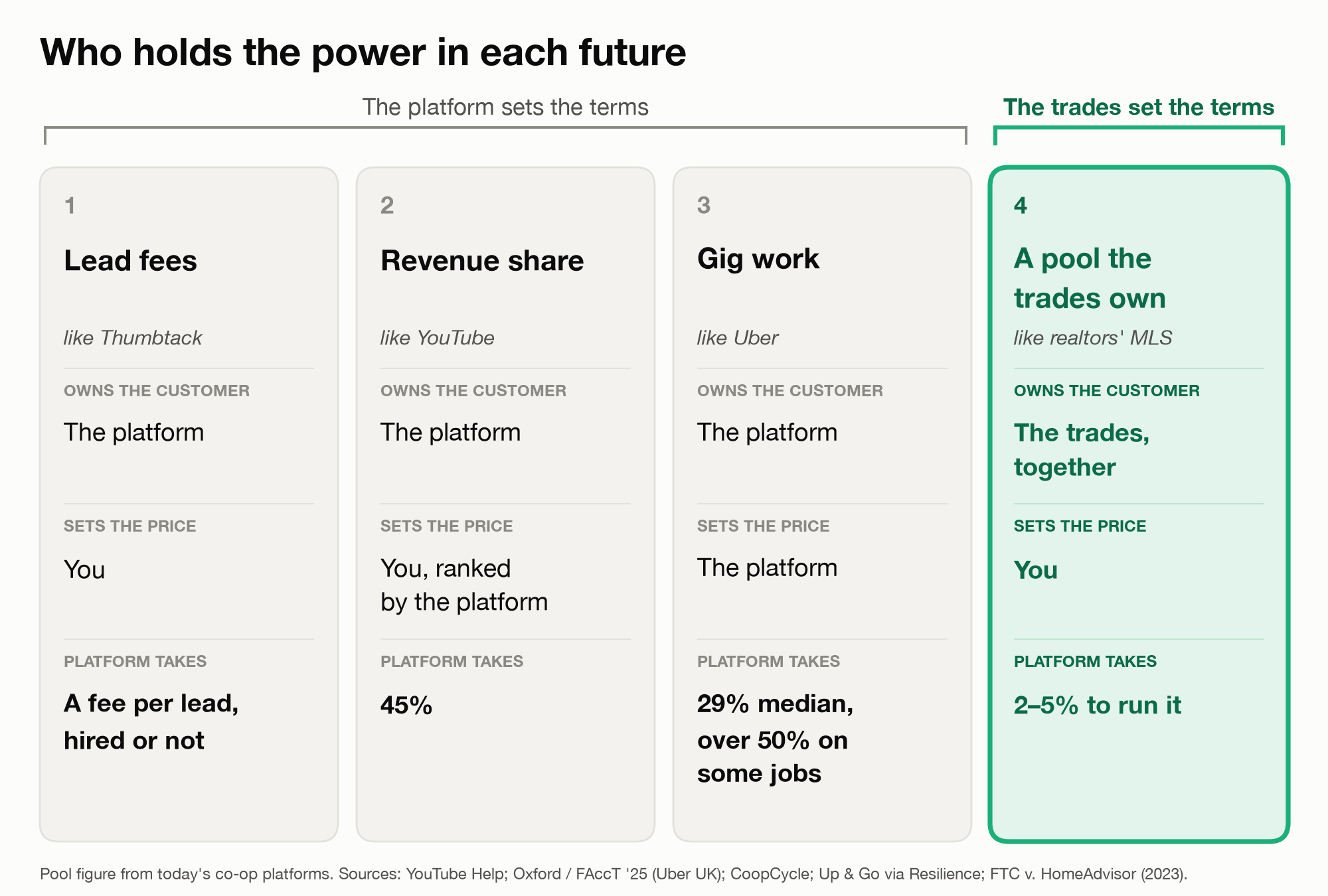
Here are four ways it could play out. In the first three the agent platforms set the terms, each taking more control than the last. The fourth is the one way I can see for the trades to pre-empt being aggregated, and it could leave them better off than they are today.
1. The lead-fee model (Thumbtack)
The least dramatic outcome is that agent platforms become the new lead marketplaces, at first by plugging into the ones that already exist. Thumbtack was a launch partner for OpenAI’s Operator agent, which “will be able to find, message and hire skilled professionals on a users’ behalf” (Thumbtack), and Amazon pitches Alexa+ as able to “use Thumbtack to discover the relevant service provider” and arrange an oven repair with “no need to supervise or intervene” (Amazon). Plugging into marketplaces that already have the supply is the easy path for an agent platform.
It probably doesn’t stay that way. Once the agent can find and book tradespeople itself, the marketplace in the middle has little left to sell, and the agent platform can take the lead fee for itself. Tradespeople keep paying per lead as they do now. The only thing that changes is the name of the middleman.
2. The revenue-share model (YouTube)
In the second, the agent platform treats tradespeople the way YouTube treats creators. Tradespeople compete to be the one the agent recommends, the way creators compete for YouTube’s algorithm, but the platform shares a meaningful part of what it earns. YouTube pays creators 55% of the ad revenue on their videos (YouTube), and the best of them build real businesses on it.
This happens if agent platforms end up competing for the best tradespeople: an agent is only as good as the plumbers it can actually book, and paying its creators is how YouTube kept them. It’s still aggregation, since the platform writes the ranking rules and can change them, but the people doing the work keep real upside.
3. The gig-worker model (Uber)
The most extreme is Uber. The agent platform stops recommending and starts dispatching: it sets the price, and the plumber fills slots the way a driver accepts rides. It happens where jobs are standard enough to price without a visit, like mounting a TV or clearing a drain, and where one platform owns enough of the demand that a tradesperson can’t say no.
That’s the gig-worker outcome: little upside, no leverage, and a platform cut that rises over time. After Uber moved its UK drivers to dynamic pricing, Oxford researchers found its median cut per driver rose from 25% to 29%, and passed 50% on some trips (FAccT ‘25). Local, licensed, physical work didn’t protect drivers from that, and it won’t protect plumbers.
4. The pooled-supply model (real estate’s MLS)
The fourth is the one the trades can choose: aggregate themselves before someone else does. If the tradespeople in a city pool their supply into one directory and booking channel they own together, an agent has one place to go for them instead of a thousand separate shops to pick from, and the leverage moves back to the trades. Each shop still competes for customers and sets its own price, which matters legally, because independent businesses can’t agree on prices together, but they can share a channel. What they own together is the front door customers come through, and it can offer what the open web can’t: checked licenses and insurance, a reputation the trades police themselves, live availability and a booking that’s guaranteed.
Real estate brokers show it can be done. Local brokers share a listings database they own together, the MLS, and Zillow has to license it to show a single house. This year Chicago’s MLS showed what that’s worth: it cut off Zillow’s feeds and erased “over half the portal’s active Chicago inventory within hours” (OnlineMarketplaces). Zillow sued under antitrust law and a judge restored the feeds, which shows both the pool’s power and its main risk.
The reason to join isn’t better traffic today; it’s keeping some power as a group over the long run. A tradesperson who stays out competes with everyone the agent can find and slowly gets turned into a gig worker, while one who joins has a say in the terms agents book on. That matters because tradespeople—especially the ones who come to your home rather than run a storefront—sit in an awkward middle: more differentiated than a commodity ride, less differentiated than an architect. And as publishers learned, that level of differentiation isn’t enough on its own once an aggregator owns the customer.
What the trades have that publishers never had is scarcity. Construction alone needs about 349,000 more workers this year (ABC, via EC&M), and an agent can’t fix a pipe itself. Today an agent needs reliable tradespeople more than the trades need any one agent. That gives a pool real bargaining power if they organize now, while the leverage is still there.
Building the pool used to be the hard part
Worker-owned marketplaces have been tried, and the ones that failed mostly failed on customers, not ownership. Loconomics, a worker-owned services marketplace, shut down in 2020; its founders “expected a few thousand users and got only a few hundred,” and concluded that “a marketplace isn’t really viable unless you have a ton of money to throw at it” (GEO). The Drivers Cooperative in New York signed up 12,000 drivers but had enough riders to support about 200 (The Workers Lab).
A worker-owned pool used to need two expensive things: a marketplace to run, and the money to fill it with customers. Agents remove both. The software is cheap to build now, and the discovery and routing that used to need a complex platform can be a list an agent reads and a number it texts. More importantly, the agent brings the customers, so the pool doesn’t have to outspend anyone on ads. It just has to be the supply the agent would rather book.
What’s left is the part that was always hard: independent tradespeople acting together. About 80% of residential construction businesses are self-employed contractors (NAHB), usually one person or a family with no time to organize, and joining only pays off if enough others join too.
Independent businesses have solved this before. In 1924 a few Chicago hardware store owners started buying together to get bulk prices. Today Ace Hardware is still owned by its local store owners, and has more than 5,000 stores in the US (Ace). Farmers have done it even longer: more than 1,000 citrus growers own Sunkist, which started in 1893 (Sunkist). Someone has to go first, and it has to be a group the trades already belong to. Getting independent workers to act as one is the job unions were built for, and trade associations already gather the shops, so either could start a pool. None has yet. ACCA, the HVAC contractors’ association, is buying AI booking tools for its members shop by shop rather than building a shared channel (PHCP Pros).
And a pool can do more than answer the agent’s call. Once the pool owns the channel, it can run its own agents for the rest of the office too: dispatch, scheduling, quotes, invoices, chasing payments, keeping track of customers. For most tradespeople, that’s not the part of the job they want to do. And it takes time away from how they earn their paycheck, doing the work. In a 2025 survey of HVAC contractors, owners of small shops averaged more than 15 hours a week on paperwork like quotes, invoices and ordering equipment (HVAC School). That’s close to two working days a week they can’t bill for. A tradesperson in a pool could spend more of the day on the work and less on the paperwork.
Picture what that looks like for an electrician in a pool. A homeowner’s agent calls the pool at 9pm about a dead circuit. The pool’s agent checks her license, her reviews and her calendar, and books her for 8am at her own rates. She wakes up to the job on her phone. The invoice goes out before she’s back in the van, and if it’s paid late, the pool chases it. She never picked up the phone, never paid for the lead and never sat down with a spreadsheet. Her whole day went to the work she’s good at, and she owns a piece of the channel that sent it to her.
Pools as a service?
A tradesperson shouldn’t have to invent a co-op from scratch. A service could run the pool for them, like a property manager for a co-op: the software, the license checks, the number an agent calls, the billing, while the tradespeople own it and set the rules. Small versions already exist. CoopCycle, a federation of bike-delivery co-ops in Europe, gives each local co-op its software, hosting and training for 2% of its delivery revenue (CoopCycle). In New York, Up & Go is a booking platform owned by three cleaning co-ops, which “receive 95 percent of the payment from every booking” (Resilience).
A channel built around the workers doesn’t need to win the whole market to change the terms. In India, the fintech company Juspay built the ride-hailing app Namma Yatri “in consultation with a drivers’ union in Bengaluru.” Drivers pay a small fee and keep the entire fare. By last year it was handling nearly 190,000 rides a day, and that was enough to push Ola, Rapido and Uber into offering drivers subscriptions too (Rest of World). The drivers don’t even own it. A pool the trades own could move the agent platforms the same way.
Agents are going to change how trades businesses get found and how they run. In one future, an agent company like Meta turns tradespeople into gig workers. In the other, that threat is what finally gets the trades acting together, and it pushes them into the best version of themselves: they own the front door, their own agents run the office, and they spend their days on the jobs they’re good at. Publishers mostly couldn’t stop their aggregation - the trades still have time to force a different outcome.