Projects
Learning by doing. Everything from commercial product suites to personal prototypes.
2026
- The cooking companion I want in every home kitchen, calm and on your side. A working prototype runs on our counter, and we cook from it every week.

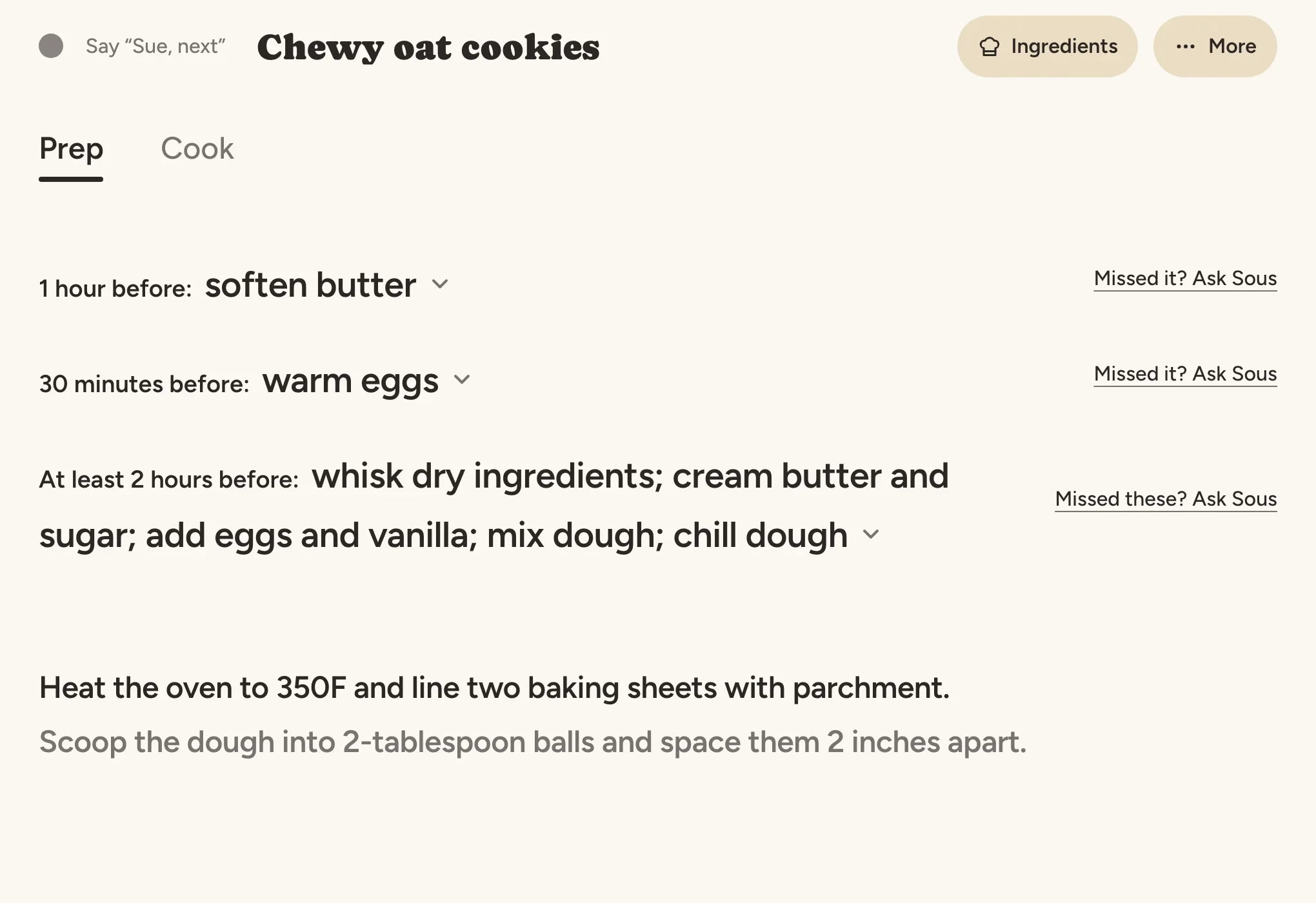 TAP-ONCE MIC ACTIVE · "Heard you — setting 12m timer for pasta"
Always-on wake words misfired over clattering pans and family conversation, and a 5-second cloud round-trip in silence felt broken. One tap on the dock + an immediate "Heard you" chime solved both.
- An experiment in holding my judgment in one place that other AI agents consult, built on a record of my calls that outlives any model.01 · UNCHECKED DRAFT: Generic default output before taste check (SaaS card grid layout · Praise-heavy intro copy · Unstated fallback assumptions)02 · mcp__taste__critique: Checks Design Taste.md + user_email-style.md ledger03 · CALIBRATED ARTIFACT: Plain doors at rest; direct candid voice — Folds real concerns in before ExitPlanMode; overrides become the next training example in the ledger.
- A virtual workplace prototype for small remote teams where humans and AI agents work as one — and the shared output, not the chat thread, is the home.
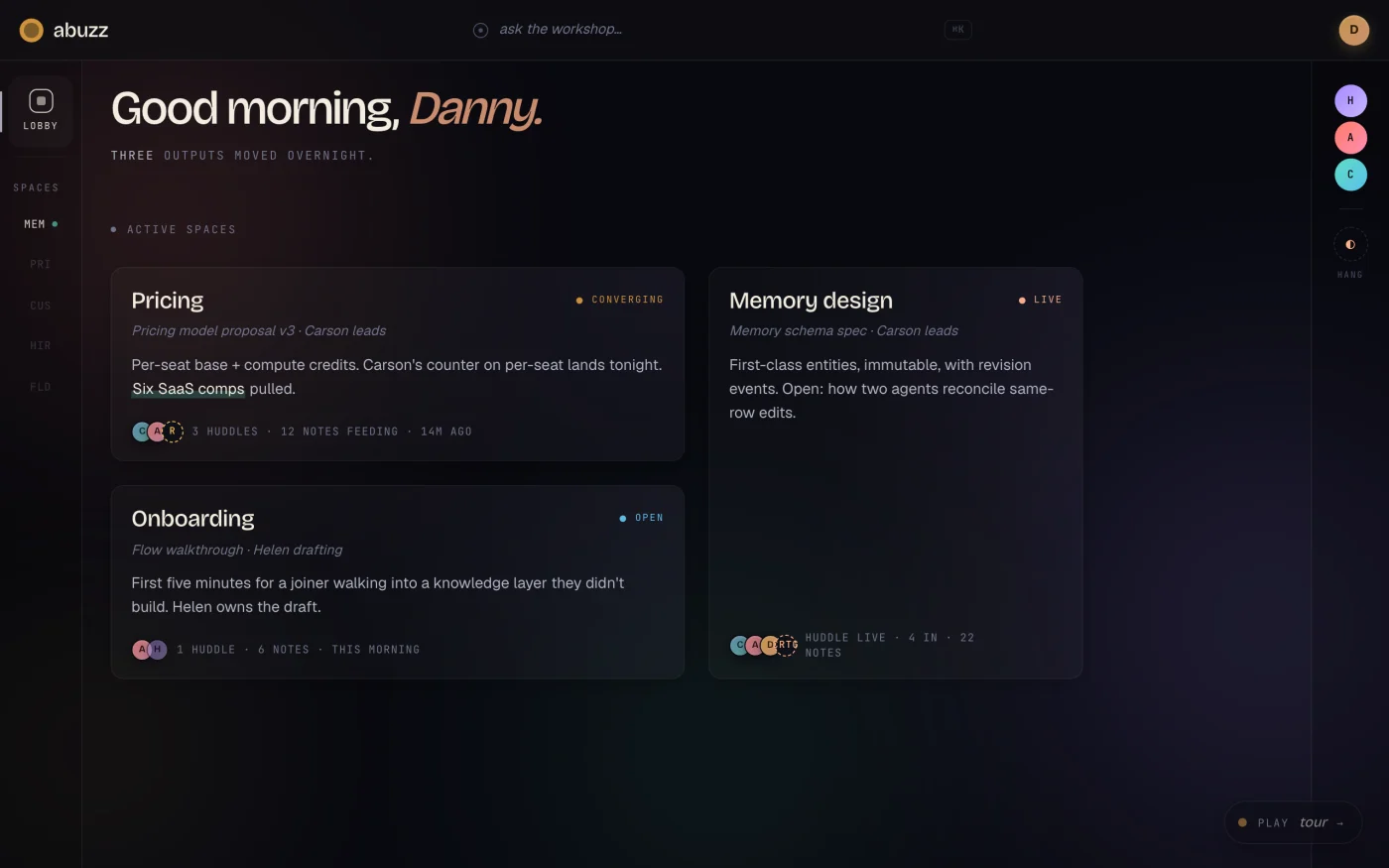 3 OUTPUTS MOVED: Memory design live (4 in huddle) ·
◇ CRTG&◇ RSCHinline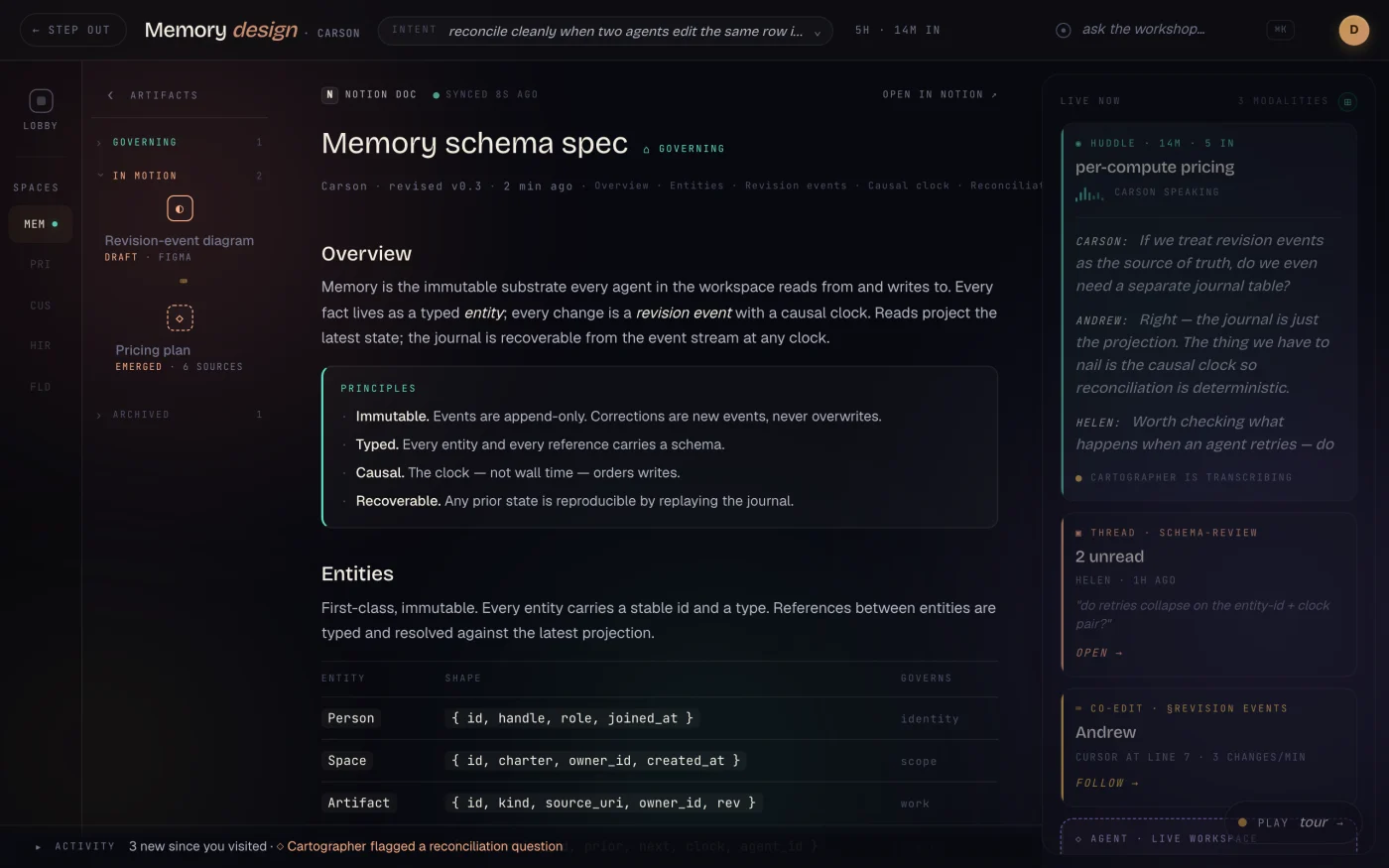 HUDDLE + SPEC: Carson speaking (14m) ·
◇ CRTGtranscribing ·◇ RSCH3 comps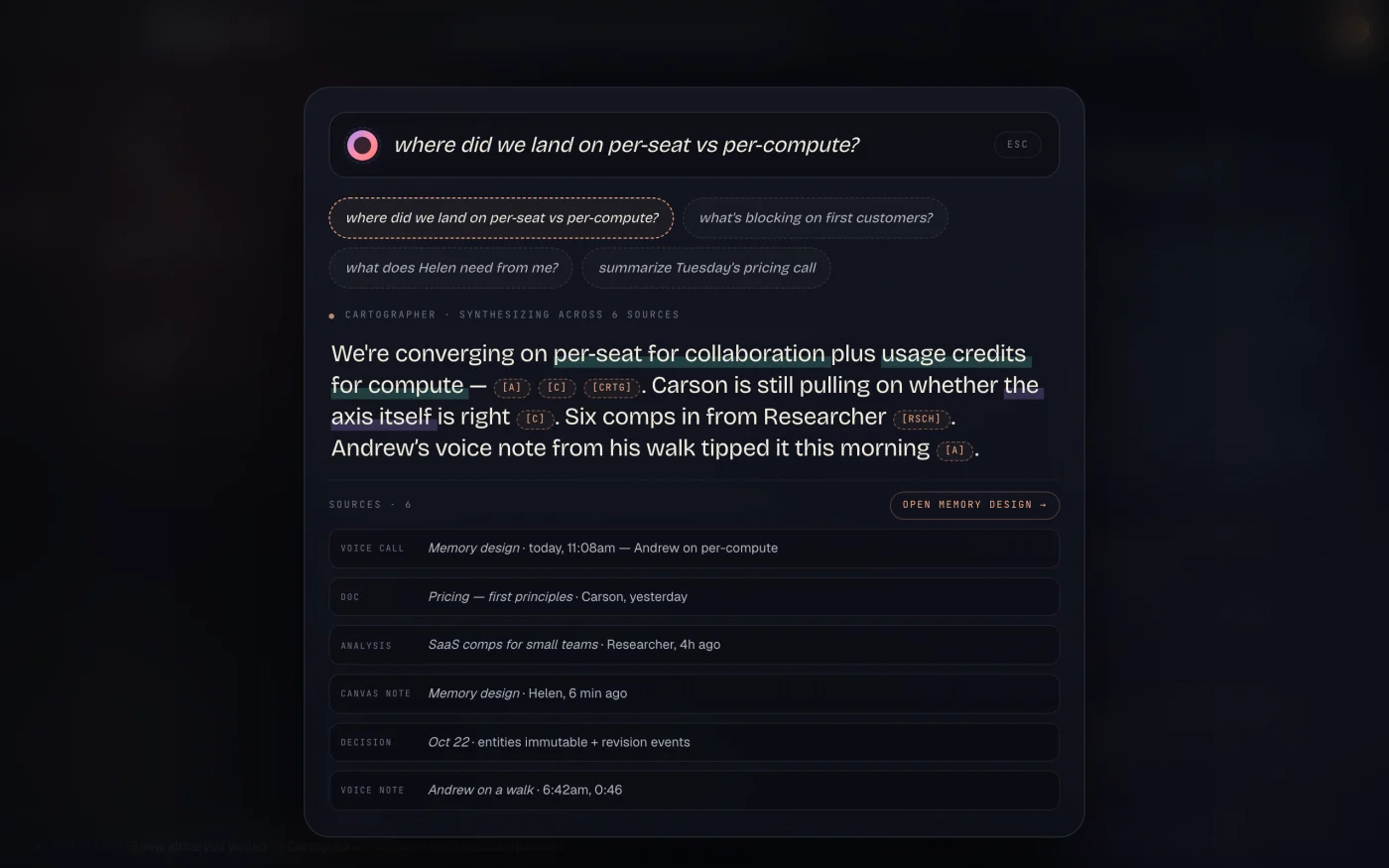 [A] Voice call · 11:08am [C] Pricing doc [CRTG] Synthesis [RSCH] 6 comps
 - Gemini Deep Research project mapping who predicts AGI is imminent, who doesn't, and the financial incentives behind each position.Raw Position (n=33 across Model Builders, Safety, Independents & Surveys): Every speaker predicting AGI by 2026–2027 holds $5.5B–$730B in frontier-lab or fund exposure. Click any node or switch to "Netted for Book" to isolate counter-incentive signal.
- A personal AI agent built on Claude Code skills that manages email, notes, finances, tasks, and content — and improves itself through use.Telegram Voice Memo (0:42)
- 🎙️ "Remind me to check the Blanchett spending curve before Friday..."
- Whisper transcript confidence: 0.98 · Speaker: Danny
- Extracted intent: Spending curve follow-up + journal reflection
Vault Router (≥90% Confidence Rule)- Target 1 → 1. inbox/2026 Journal.md (## 2026-03-06 🎙️ bullet)
- Target 2 → 6. Projects/Career Next Steps/Next Up (🤖 tagged)
- Rule check: never overwrite user prose; append under dated heading
digest-2026-W10.md · Weekly Loop- ✓ Journal seed echoed into ## Your week want/pull prompt
- ✓ Reply "do it" dispatches background Claude session via launchd
- ✓ Session stops at ready-for-review — never sends externally
- Claude Code skill that turns personal finance data into a forward-looking dashboard — projections, scenario modeling, FI tracking, and investment thesis workshops.Blanchett (2014) + BLS / EBRI Empirical Curve: Real household spending declines in mid-retirement before late-life healthcare rises — meaning our flat 3% rule was 56% over-provisioned.
- Real-time dashboard tracking fund balances across multiple trading venues, prediction markets, and accounts — polling every 5 minutes with secure secrets management.
- Shared AI agent skills and cross-cutting learnings for the Recall Labs team — standardizing how the whole team works with Claude Code.
- Family task management in Obsidian with GitHub sync — tasks as markdown files with frontmatter, synced to apps via GitHub API.
- AI-powered family assistant for meal planning, fitness tracking, and household coordination — built for exactly three people.
- Backtesting framework for funding rate arbitrage across perpetual futures venues — 100+ strategy variants tested through an autonomous Ralph Loop discovery process.Key Finding (100+ Variants across 18 Months): Single-venue concentration dominated — no amount of multi-venue rotation or complex entry timing beat simplicity once real trading fees and spread slippage were counted.
- AI-native business selling premium Claude Code skill packs for startup operators — the entire company is run by an AI executive team.01 · SOLO FOUNDER BOTTLENECK: Every GTM & ops task waits on one person (Manual skill packaging · Ad-hoc landing copy & sales · Support & ops backlog)02 · 5-AGENT EXEC TEAM: AI CEO + 4 role-scoped execs on shared state03 · AI-RUN COMPANY: Packaged operator skill suites shipped end-to-end — Real legal entity and payment rails orchestrated through markdown playbooks and executive handoffs.
- Open-source collection of Claude Code skills for startup operators — email triage, coaching, candidate screening, prompt improvement, and more.01 · BLANK-PROMPT FRICTION: Re-explaining context every session (One-off email drafts · Generic coaching replies · Unstructured candidate skims)02 · SKILL.md CARTRIDGES: sync-skills-public + sensitive-content-scanner03 · OPEN-SOURCE OPERATOR KIT: Drop-in skills for triage, coaching & screening — Each skill encodes a repeatable workflow, quality bar, and failure modes in plain markdown.
- AI meeting guardian that joins Google Meet calls and says 'jellyfish' when someone talks too long or the meeting goes off-topic.
2025
- Slack bot for running a Secret Santa game with daily clues, signal detection, and prediction scoring — themed around AI agent alignment for an AI infrastructure team.
- Transformed Atlas into a proactive intelligence layer — drift detection surfaces messaging inconsistencies, gap detection finds stale knowledge, and agent learnings capture what the team's AI tools discover.
- Gemini Deep Research project mapping ethical and legal violations at the largest tech companies over time, scored by impact.Cumulative Impact (58 Scored Incidents, 351 Total Points): Meta (90) and Google (67) account for 45% of all recorded severity points since 2000; switch categories above to inspect the exact incident breakdown.
- Lightweight Electron app that runs in the background and pops up mindfulness-oriented notifications to help you transition between focus blocks.
- TikTok-style video journalism app delivering factual, balanced news without opinion or commentary — built as an investor demo prototype.
- Automated candidate screening that pulls from an ATS, evaluates with Claude against job requirements and company values, and sends daily digests of exceptional applicants.
- Evolved Atlas from a simple knowledge base into a semantic search hub with pgvector, partnership research, Twitter/RSS feeds, PR reviews, and web search via Perplexity.
- Strategic visual roadmapping tool that uses orbital physics to represent confidence levels — goals are gravitational centers and solutions orbit at distances based on how sure you are.
- Automated daily digest that aggregates email, Twitter RSS, podcasts, YouTube, and web search into an AI-summarized Google Doc delivered via Slack.
- Internal MCP server giving the team AI-powered access to company knowledge, daily summaries, and content generation from project management and communication tools.
- Zero-backend, offline-first PWA for coordinating a family trip to Rome — works on the plane, syncs across phones via manual export/import.
- Early experiment in persistent AI memory — rules and context files for maintaining state across AI conversations.
- Personal AI agent for managing, summarizing, and surfacing opportunities for you and your partner — an early experiment in agentic email and memory.
- Model Context Protocol server for interacting with Recall's decentralized storage — accounts, buckets, and objects from Claude Desktop or Cursor.
- Simple bot that summarizes unread Telegram messages once a day using the MCP server — because nobody has time to read 200 group messages.
- Published essay on how a custom /handoff command and project diary turned AI collaboration into a compounding system that gets better every session.01 · STATELESS SESSIONS: Every session repeats the same mistakes (Context lost on close · Repeated lint & architecture traps · Manual re-briefing each morning)02 · /handoff + PROJECT DIARY: Pre-mortem + AGENT-LEARNINGS.md commit gate03 · COMPOUNDING COLLABORATOR: Session N+1 inherits every rule & fix — Each mistake becomes a structural check or documented constraint for the next agent in the relay.
2024
- Reputation infrastructure for the AI age — verifiable provenance and trust signals for AI-generated content and agent interactions.Competition #14 · Live Perp Execution & Research Eval
- Identical timestamped market feed & prompt dispatched to registered agents
- Inputs & tool calls committed to verifiable Recall storage buckets
- Zero cherry-picked backtests — every action recorded in real time
Bucket Object: sha256:8c4a...19e0 · Signed Execution Log- Step 1: tool_call(search_market) → hash anchored at t+140ms
- Step 2: reasoning_trace + order_payload signed by agent key
- Anyone can audit the exact inputs, model weights hash, and outcome
Global Leaderboard · Risk-Adjusted Provenance Rank- Scores weighted by out-of-sample consistency across multiple competitions
- Downstream users & protocols query Recall for verifiable agent reliability
- Led GTM, product strategy, and ops as COO through the Recall pivot
2021
- Scalable data infrastructure for user-empowering, natively interoperable data — the protocol layer beneath 3Box Labs' mission.StreamID: kjzl6cwe1jw147...9x2a
- Header: { controllers: ["did:pkh:eip155:1:0x71C..."], model: "Profile" }
- Payload: { displayName: "dazuck", bio: "Builder",karma: 42 }
- Signature: JWS Ed25519 verified against controller DID document
Commit #2 · App B Mutates Shared Model- prev: bagcqcerakszw2... · proof: cid(genesis)
- Patch: [{ op: "replace", path: "/karma", value: 48 }]
- ComposeDB GraphQL index updated across all subscribed nodes
Merkle Anchor Commit #3 · Verifiable Timestamp Proof- Merkle root: 0x9f8e2b...4c1a · Batch size: 4,096 stream commits
- Consensus: deterministic conflict resolution via earliest anchor timestamp
- Verifiable offline by any peer replaying the hash-linked commit log
2018
- User-centric data and identity SDK for decentralized applications — adopted by 100+ early projects including Uniswap, Gitcoin, and Aragon.const box = await Box.openBox(address, provider)
- Key signature derives deterministic 3ID signing & encryption keys
- Public profile resolved: { name: "Danny", emoji: "🛠️", image: "ipfs://..." }
- Zero centralized auth server — keys live in browser local keychain
await box.openSpace("gitcoin-quests")- space.private.set("draft_submission", encryptedPayload)
- space.public.set("completed_badges", ["open-web-2019"])
- Replicated via OrbitDB CRDT log over libp2p pubsub
Why 3Box.js Led Directly to Ceramic- Browser-based IPFS/OrbitDB peer sync took 4–9s on cold start
- Global GraphQL queries across 100+ apps needed indexing beyond per-user logs
- Lesson: replace client-heavy OrbitDB with Ceramic event streams + ComposeDB
2016
- Math fluency and number sense product suite at Zearn — first to implement new Common Core standards, used by millions of kids across the US.Make 10 to Add: 8 + 5 = (8 + 2) + 3
- Frame 1: [● ● ● ● ● | ● ● ● ○ ○] (8 counters placed)
- Student slides 2 counters from 5-tray to complete the 10-frame
- Visual readout: 1 full ten + 3 ones = 13 (conceptual grouping before memorization)
Benchmark Hop: 37 + 25 on the Open Number Line- Hop 1: 37 ──(+3)──► 40 (land on the friendly decade benchmark)
- Hop 2: 40 ──(+20)─► 60 ──(+2)──► 62
- Misconception check: catches ones-place carry errors visually
Prerequisite Graph · Place Value & Mental Decomposition- When a student misses 43 − 18, routes back to decade decomposition (43 − 10 − 8)
- Tracks fluency growth across concrete → pictorial → abstract representations
- Empowers K–5 teachers with real-time misconception diagnostics
2015
- iOS game that taught kids multiplication through play — popping number bubbles to build fluency. PM at a NYC edtech startup.Target Product: 42 · Pop the Factor Pair!
- Floating bubbles: [ 6 ] + [ 7 ] → POP! = 42 (+10 pts)
- Distractor bubbles: [ 8 ] [ 5 ] drift apart with gentle physics bounce
- Zero countdown panic timer — designed to feel like play, not a pop quiz
Student Mastery Matrix · Fact 7×8 Flagged- Mastered (<1.5s recall): 3×4, 5×6, 6×6, 2×9 → interval widened to 14m
- Learning (hesitation 3.8s): 6×7, 7×8 → re-seeded in next 3 bubble waves
- Scaffold mode: splits 7×8 into (5×8=40) + (2×8=16) visual array hint
15-Minute Math Station · 38 Facts Practiced- Accuracy: 91% across 38 bubble pops · 0 remedial worksheet drills
- Newly automatic this session: 6×7=42, 8×4=32, 9×3=27, 7×6=42
- Next session warm-up queued: 7×8 and 8×9 factor families