Is Every Scene a Store?
AI visual search and one-tap checkout is making every scene we see shoppable. Product-in-scene could be the next big ad surface, with new opportunities for both large platforms and smaller brands.
Increasingly, every frame we see is a potential advertisement. It’s two taps on my phone to look up the robe worn in The Gentlemen on Netflix, the kid’s wagon rolling by on the street, or the lamp on Dwarkesh’s desk. It’s two more taps to buy each.
For most of our time online, ads sat next to searches or content. Instagram shopping, influencer marketing, and sponsored content have blurred that over the last decade, with products and services often part of the frame itself. Amazon began letting Prime Video viewers shop alongside shows in 2025, now across more than 8,000 titles and directly off the screen on 600+ (Amazon). Until now, these have relied on a closed-loop system to push ads into a frame.
AI is changing that by creating the opportunity for discovery and purchasing on anything we see, anytime. Google now handles more than 50 billion visual searches a month (Google), up from about 20 billion in 2024 (Google), and Circle to Search sits on 580 million Android phones (Google). Personal AI agents like Meta’s Muse and the startup Instinct take the natural next step, going from search to checkout for you and pausing only for your OK.
So every scene is becoming a storefront. That’s a major shift for advertising, who gets onto the shelf, and how. Is it also an opportunity for smaller brands and sellers?
Advertising is merging into the frame
Product placement is clearly trending up.
- Major platforms are all building the buy button into the picture: Amazon’s Shop the Show, YouTube Shopping with more than 1.3 million channels enrolled (PPC Land), NBCU’s shoppable TV (Modern Retail), and Instagram, which added Amazon as an official affiliate program in November 2026 (Instagram) and has tested AI that tags products in creators’ photos automatically (Affiverse).
- US product placement and creator ad spend together went from $27B in 2021 to roughly $58B in 2025 (PQ Media; IAB).
- Creator commissions, a new adjacent surface, came to an estimated $2.1B in 2025 on TikTok Shop, YouTube, Amazon, LTK, ShopMy and Mavely, and shoppable TV ads about $1.7B more (on top of the $58B).
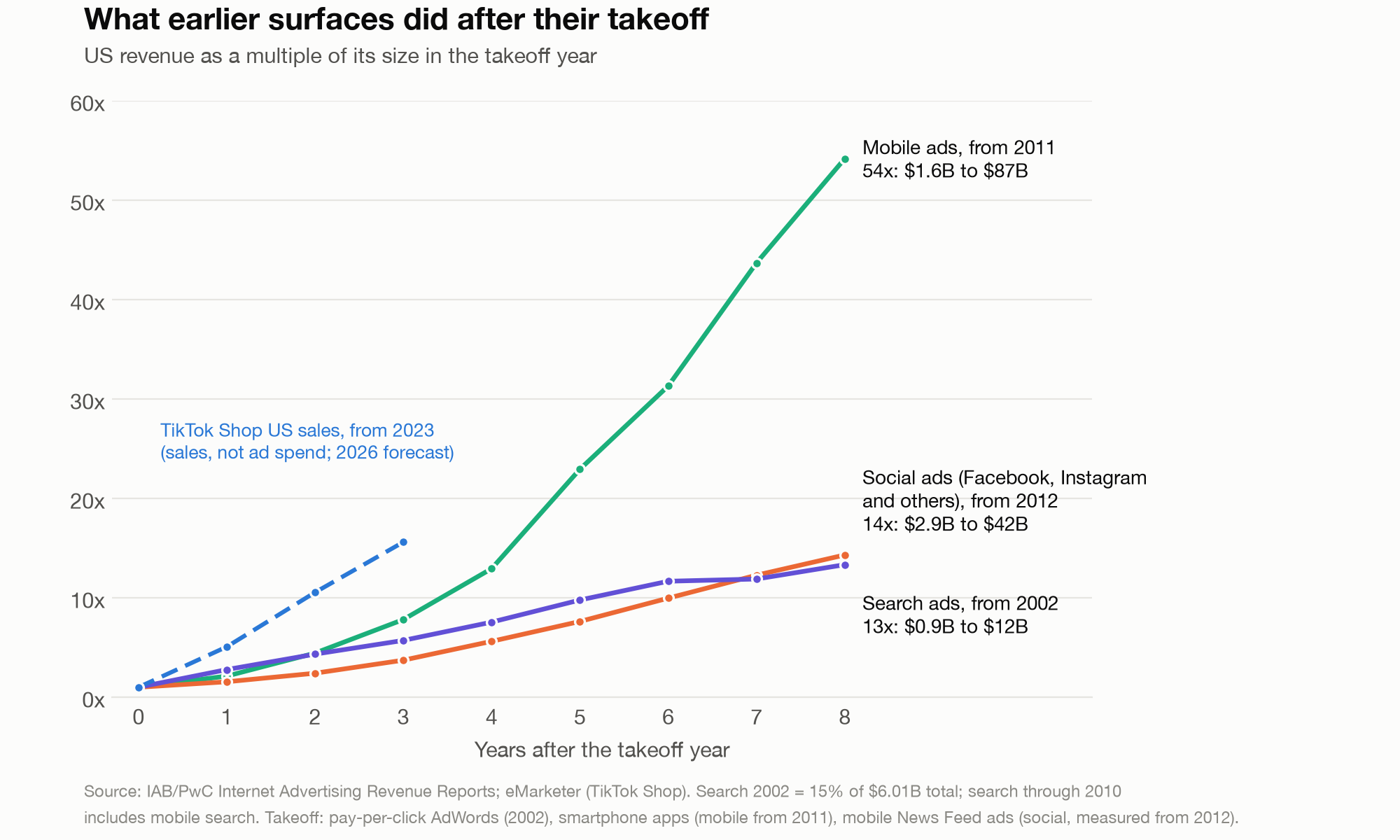
New ad surfaces tend to start small and then spike once the enabling technology lands. After the iPhone and the app store, US mobile ad revenue went from $1.6B in 2011 to $87B eight years later (IAB). Social went from $2.9B in 2012 to $42B eight years later, and search from about $0.9B in 2002, when AdWords switched to pay-per-click, to $12B by 2010. Measured against where each started, that’s 13x for search, 14x for social and 54x for mobile.
Shoppable video has flopped before. Instagram pulled its shop tab in 2023 (TechCrunch), Amazon shut its Inspire feed in 2025 (Tubefilter), and OpenAI pulled Instant Checkout from ChatGPT in March 2026 (Forrester). Those attempts asked for habit changes from both viewers (scan this QR code, tap this tab) and content producers (build every scene for shopping).
But now, with image recognition in every pocket, every scene is shoppable with whatever is already in it by default. It’s going to happen, it’s just a question of how and how big. And this comes when ad money is looking for a new home. Clicks out to other sites are shrinking: 68% of US Google searches now end without a click (SparkToro), and open-web ad platform The Trade Desk just posted its first revenue decline since going public (PPC Land).
Spend is already moving to places where people watch and buy in one spot. TikTok Shop’s US sales went from about $1.5B in 2023 to $15.8B in 2025 (eMarketer). How big might product-in-scene get in the next few years? If it follows linear growth or search ads, ~$100B by 2030 ($120–137B by 2033); if it follows social ads, ~$126B ($175B by 2033); if it follows mobile ads, about $153B ($230B by 2033).
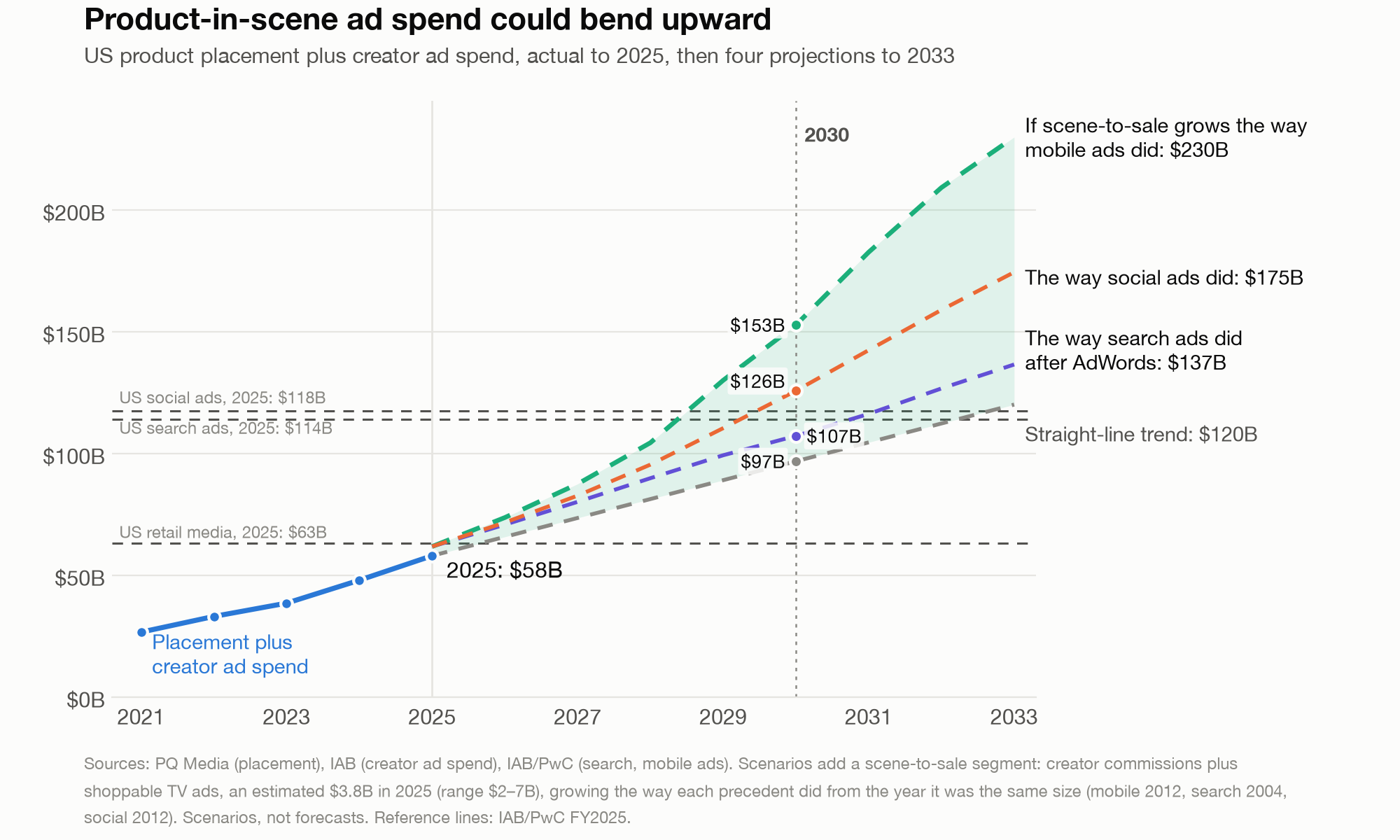 US search and social ads were each ~$115B in 2025 (IAB), so on the higher path product-in-scene would be bigger than today’s whole search market by 2030.
The flow: from scene to purchase
Product-in-scene has been limited until recently because the whole flow was clunky. A product got into a scene through a paid deal or as a free prop, and a viewer who wanted it had to describe it to a search box or scan a QR code.
Now identifying what’s on screen is far easier - which is what unlocks this - and finding a seller and buying have collapsed into the same motion.
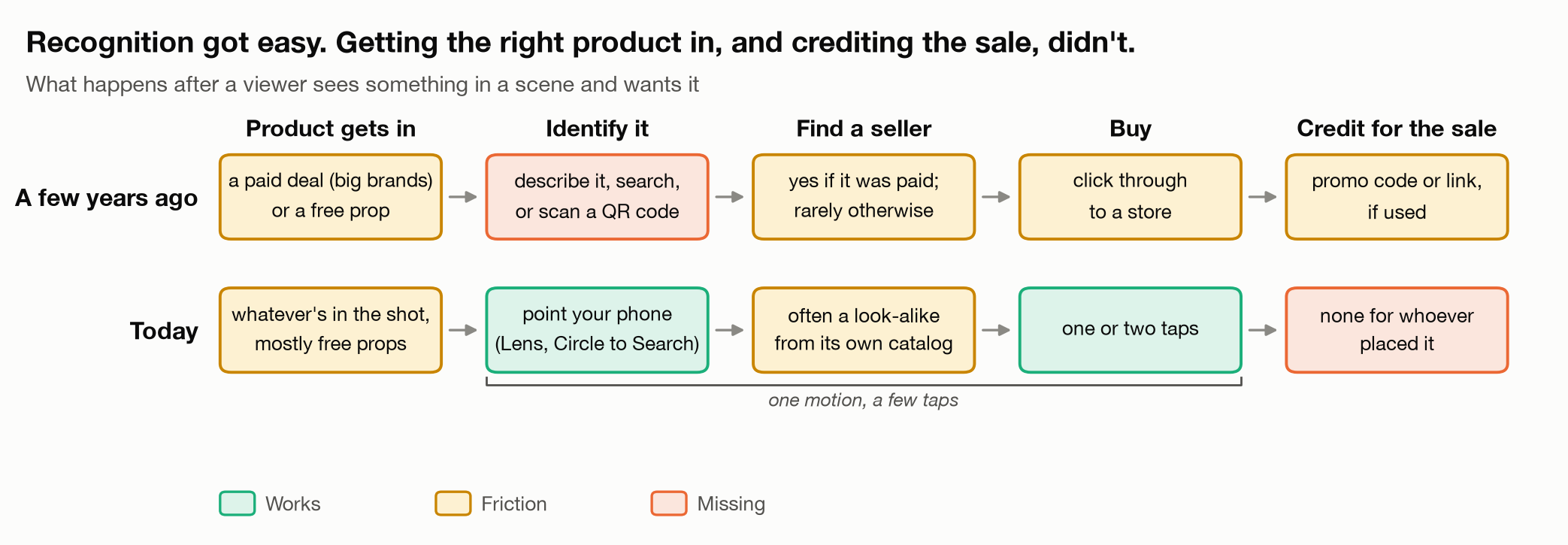
The gaps now sit mostly at the two ends:
- There’s not a scaled and easy way to place products, so most things seen are still unpaid & unrewarded (essentially ‘unused ad space’).
- The identifier sells mostly from its own catalog today, so the viewer often gets a look-alike rather than a direct match and there’s no feedback loop to give referral credit for a successful buy.
That’s the opening today: closing the loop to turn this into a scaled ad surface rather than a platform-specific one by offering a catalog and system to place products in scenes.
Today, placement agencies estimate over 90% of the products on screen aren’t paid for (Hollywood Branded). This is great for those who get placed, but it means the media companies lose on ad revenue and there’s no viable way in for the vast majority of brands - especially small ones. Need a hot sauce for a TV shot? You could grab a Tabasco, or create an unlabeled version (as Discovery does, to avoid free products undercutting paying sponsors (Warner Bros. Discovery)). But why not grab a more niche one from a catalog of brands that fit the shot and pay on commission?
A creator or TV prop master browses for what they need, picks a product that fits, and earns a commission with no promo code to read out.
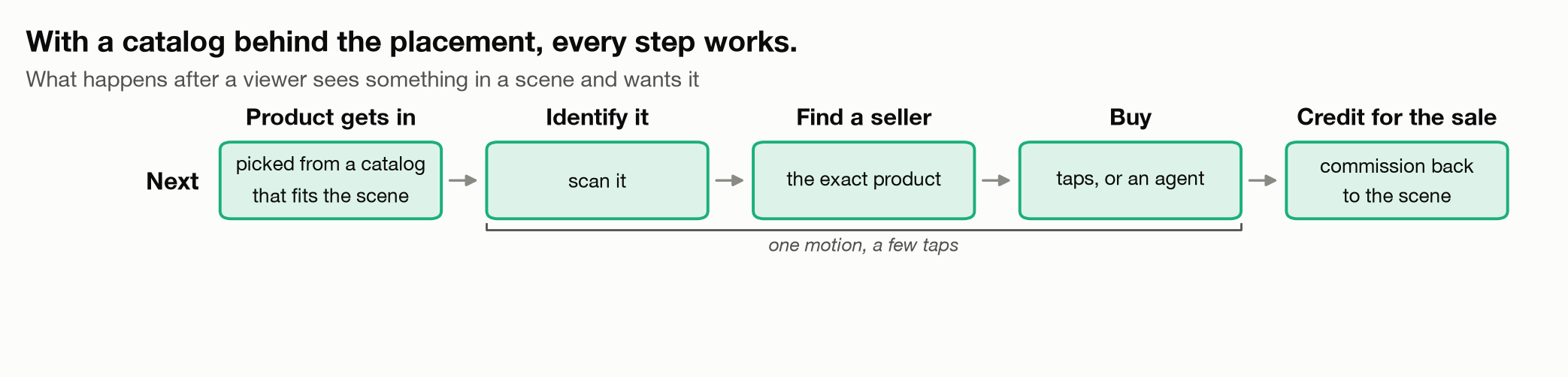 In addition to the catalog, succeeding in this will require making it easy for any identification tech (e.g. Google Lens) to match the exact product , which with open catalogs is straightforward - especially as AI shopping agents already buy straight from machine-readable catalogs like Shopify’s. Tying that purchase back to the specific scene that sparked it, and paying out a reliable commission, is probably the more challenging part, but there’s strong incentive throughout the chain to make it work.
Who’s positioned to build it?
What’s the prize for the platform that wins here? On the paths above, the paid-on-sale slice alone grows from ~$3.8B today to ~$10–55B a year by 2030. Small brands get about a third of TikTok Shop’s purchases (TikTok). Since commissions average ~13–15% of the item price, a company that became the default catalog for a quarter of small brands’ share would be moving $3–18B in goods a year through scenes by 2030 and, at a 15% marketplace fee (Faire), earning roughly $0.5–2.8B on that platform alone (a lighter layer that only takes a cut of the commission, the way ShopMy does, would earn closer to $0.1–0.5B).
Who’s likely to build this? The two obvious assets that a company can bring to this are an existing catalog of brands/products to place, and a media surface on which to place them. There are four types of companies that bring one or both of those.
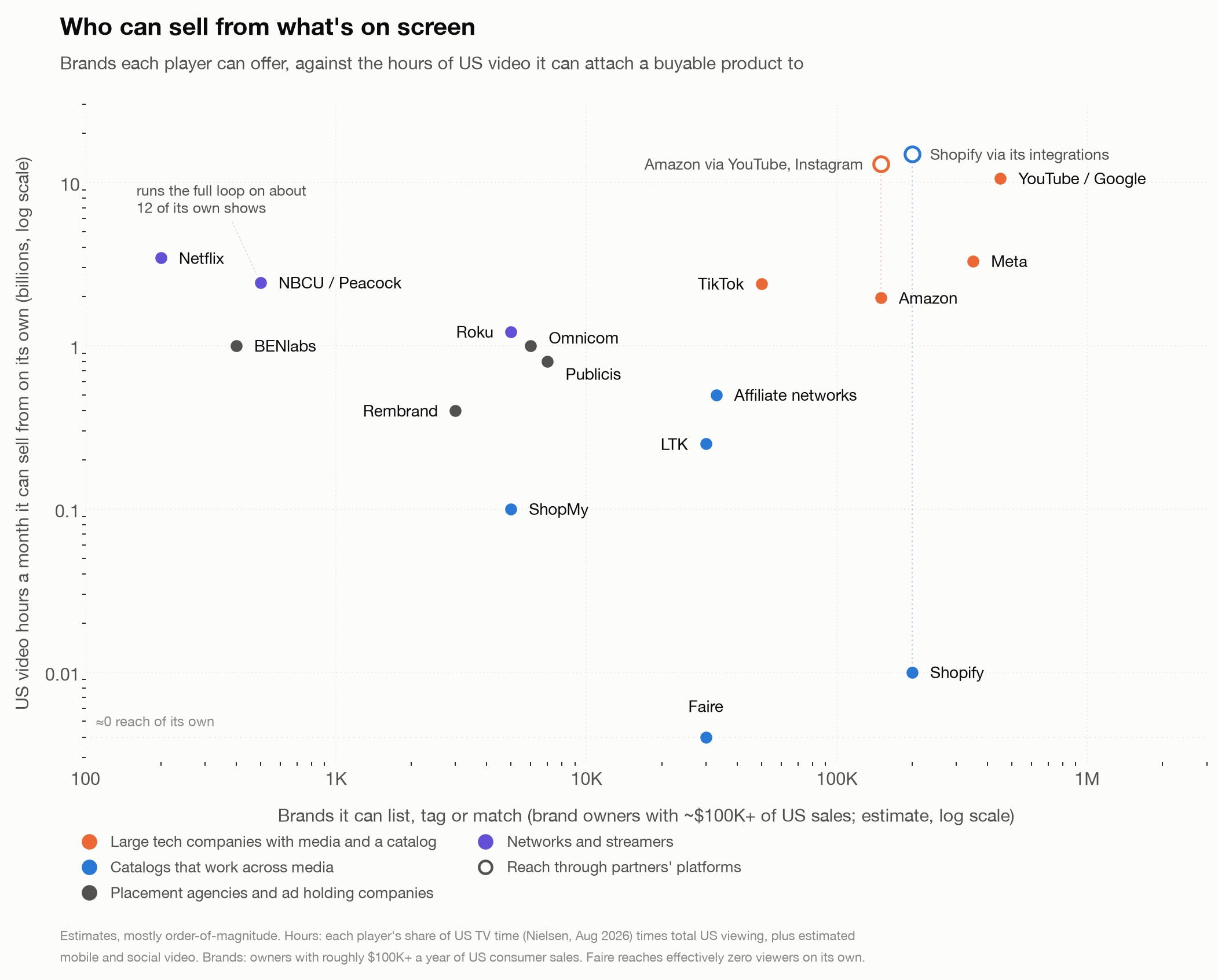
Large tech companies with media and a catalog. YouTube and Google, Meta, Amazon and TikTok could build this into what they already run: their recognition matches what’s on screen to their own catalogs, creators tag products in their videos, and checkout happens without leaving the app. YouTube already draws on Shopify’s and Amazon’s catalogs, and Instagram just added Amazon. They own the screens, the recognition and the checkout, and most brands are already listed with them. This is the likeliest path. The downside is limited cross-platform placement, which means more failed identifications or ‘look-alike’ purchases - limiting the attribution-based economics. For companies this size it would be a feature on top of a business they already run (Google’s search business alone brings in about $63B a quarter).
Catalogs that work across all media. Platforms like Shopify and Faire, along with the affiliate networks, LTK and ShopMy, could offer placement as a service to their existing sellers. Faire already matches 100,000 independent brands onto boutique physical shelves it doesn’t own; matching them onto on-screen shelves is the same wholesale job in a new medium. They have the brands and no screen of their own to protect, so they can work with everyone, and their brands are more distinctive than retailers like Amazon or Walmart - and accordingly pay more, perhaps 13–15% to creators against Amazon’s 1–4% (Amazon). What they lack is reach. Shopify gets to viewers primarily through other companies’ platforms, and Faire barely at all, so they’d need the recognizers to cooperate. Shopify has an existing consumer purchasing and fulfillment flow; Faire and others would need to build one. For Faire, a business with about $0.6B in annual revenue (Faire), this could be company-changing; for Shopify it would be a meaningful new line.
Placement agencies and ad holding companies. BENlabs, Rembrand, Omnicom and Publicis could sell placement on commission to the brands they already represent, inserting products digitally where a scene has already been shot (ContentGrip). They have the relationships with studios and creators, and Publicis already owns an affiliate network, CJ. But their clients are big brands that pay up front, so this would either require pushing products in a more traditional placement model vs. the distributed model envisioned above, or diversifying to serve thousands of small brands paying on commission - which is a very different beast. It may also compete with their current fees and placement channels. This seems like a tough fit.
Networks and streamers. NBCU, Netflix, Roku and soon Fox, which is buying Roku (TheWrap), own the shows or the TV screen. NBCU already runs a free marketplace that “brands of any size” can join, running across about a dozen mostly unscripted shows like Traitors and Top Chef (Modern Retail). They decide what’s in the shot, and commission is income that doesn’t take up an ad slot at a time when streaming ad prices are falling (Digiday). But per placement the money is small (matching an $80,000 paid integration (Digiday) takes about 13,000 orders of a $40 item), and few of them have a catalog. It would add to their business while competing with the paid placements and ad slots they already sell, and independently they may not have the scale to gather an ecosystem around this on their own.
New ad surfaces tend to open doors for a particular kind of company. AdWords’ first self-serve customer sold live lobsters by mail (Google), and Facebook ads built the direct-to-consumer wave (MarTech). Paid placement, by contrast, has needed $40–300K/year agency retainers (The Hustle) and long pre-production lead times.
Product-in-scene probably suits a particular kind of business too: physical products distinctive enough that a viewer wants that particular one, not a look-alike. The products also need to show up clearly on screen, sit at an impulse price, carry margins that can pay a 13–15% commission, and have enough stock to fill a run of orders when a scene lands. The more distinctive the product, the more an exact match is worth - as long as the seller can meet a demand spike.
At best, this opens a new channel for distinctive small brands and diversifies retail a bit away from the giants. More likely, Amazon and Google capture most of the volume by wiring their media and catalogs together - leaving an open catalog layer with only the slice where a look-alike misses the point.