Projects
Learning by doing, from product lines to personal prototypes.


2026
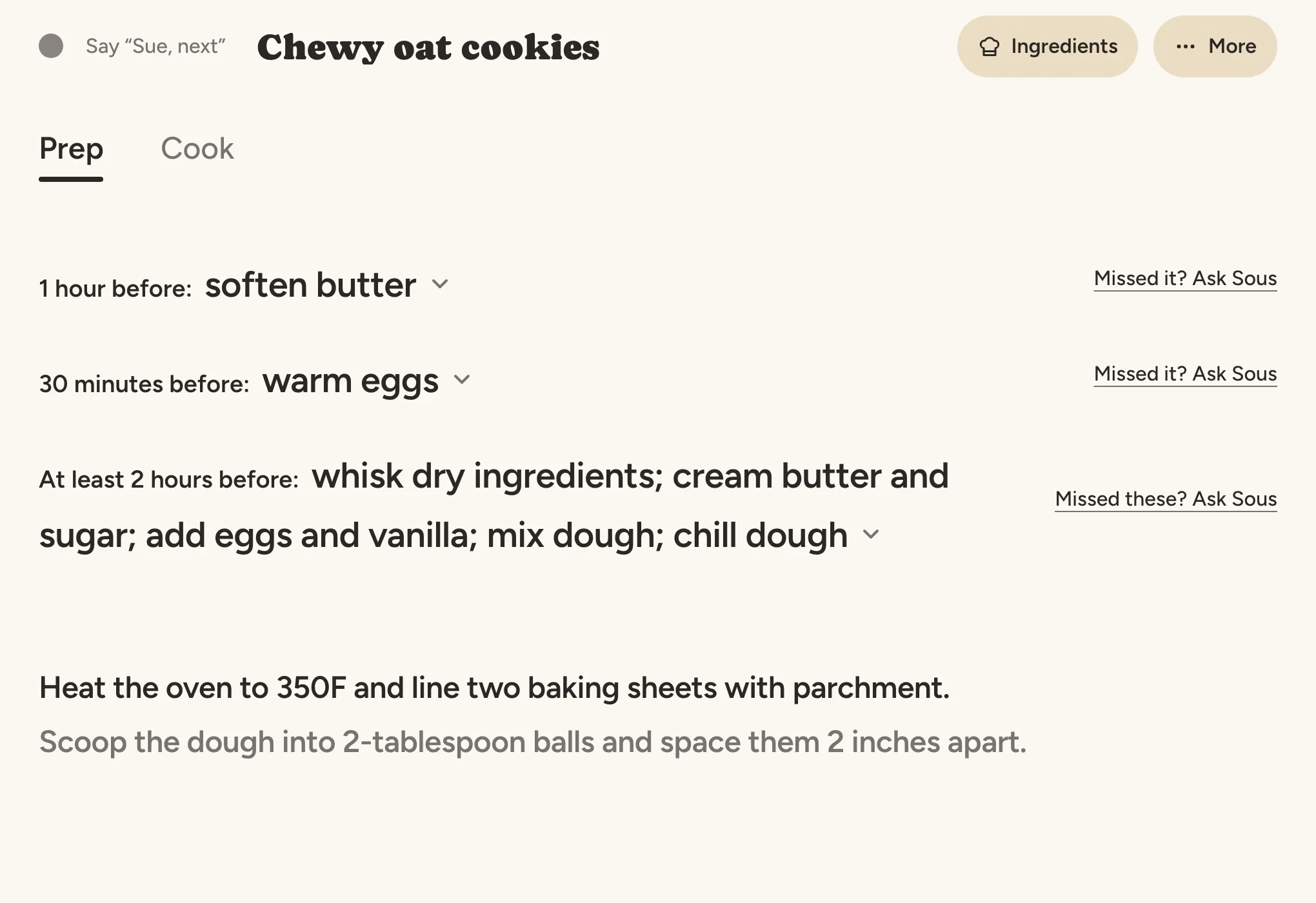
- The cooking companion I want in every home kitchen, calm and on your side. A working prototype runs on our counter, and we cook from it every week.
 TAP-ONCE MIC ACTIVE · "Heard you — setting 12m timer for pasta"
Always-on wake words misfired over clattering pans and family conversation, and a 5-second cloud round-trip in silence felt broken. One tap on the dock + an immediate "Heard you" chime solved both.
projectAny recipe is now a search away, and an AI will write you a new one in seconds. What a home kitchen still lacks is a companion: something that knows what your family likes, gets you through the cook with wet hands, and remembers how you made it last time. Most cooking apps answer with more scrolling, more pop-ups, and more screens to manage.
- An experiment in holding my judgment in one place that other AI agents consult, built on a record of my calls that outlives any model.01 · UNCHECKED DRAFT: Generic default output before taste check (SaaS card grid layout · Praise-heavy intro copy · Unstated fallback assumptions)02 · mcp__taste__critique: Checks Design Taste.md + user_email-style.md ledger03 · CALIBRATED ARTIFACT: Plain doors at rest; direct candid voice — Folds real concerns in before ExitPlanMode; overrides become the next training example in the ledger.project
This project is testing out a light non-consensus thesis I have: that in a multi-agent future, we'll all want an agent dedicated 100% to understanding 'us' and injecting that into every workflow with other agents.
- Knowledge and evaluation infrastructure for AI agents: open competitions and verifiable skill markets.Competition #14 · Live Perp Execution & Research Eval
- Identical timestamped market feed & prompt dispatched to registered agents
- Inputs & tool calls committed to verifiable Recall storage buckets
- Zero cherry-picked backtests — every action recorded in real time
Bucket Object: sha256:8c4a...19e0 · Signed Execution Log- Step 1: tool_call(search_market) → hash anchored at t+140ms
- Step 2: reasoning_trace + order_payload signed by agent key
- Anyone can audit the exact inputs, model weights hash, and outcome
Global Leaderboard · Risk-Adjusted Provenance Rank- Scores weighted by out-of-sample consistency across multiple competitions
- Downstream users & protocols query Recall for verifiable agent reliability
- Led GTM, product strategy, and ops as COO through the Recall pivot
2025–2026 · productAs COO, I led go-to-market, product strategy and operations through the company's merger and its pivot to an open evals network for AI, which we ran as an AI-native operating experiment.
- A virtual workplace prototype for small remote teams where humans and AI agents work as one — and the shared output, not the chat thread, is the home.experiment
A virtual workplace prototype for small remote teams where humans and AI agents work as one — and the shared output, not the chat thread, is the home.
- An always-on personal agent I run myself. It's useful every day, and it taught me that its worst failures were the ones that reported "ok".01 · SILENT PLUMBING DRIFT: 285× false "ok" heartbeats on a hung sync (Sync hung on CLI flag change · Unseen message backlog · Unverified self-reported status)02 · SOURCE-RECEIPT INVARIANT: Pinned deploy + pre-snapshot + mandatory source msg ID03 · VERIFIED ALWAYS-ON AGENT: Independent box across messaging threads, Telegram & Vault — Every alert cites its source message ID; health checks verify downstream state rather than model claims.project
For six days, the job that syncs my messaging threads reported "ok" every 30 minutes while syncing nothing. The messaging service had started rejecting the old client at the handshake, and the sync tool exited cleanly on total failure. It logged 285 runs, every one "ok" and every one a failure. I found it by luck, during a routine upgrade.
- Gemini Deep Research project mapping who predicts AGI is imminent, who doesn't, and the financial incentives behind each position.experiment
Gemini Deep Research project mapping who predicts AGI is imminent, who doesn't, and the financial incentives behind each position.
- A personal AI agent built on Claude Code skills that manages email, notes, finances, tasks, and content — and improves itself through use.Telegram Voice Memo (0:42)
- 🎙️ "Remind me to check the Blanchett spending curve before Friday..."
- Whisper transcript confidence: 0.98 · Speaker: Danny
- Extracted intent: Spending curve follow-up + journal reflection
Vault Router (≥90% Confidence Rule)- Target 1 → 1. inbox/2026 Journal.md (## 2026-03-06 🎙️ bullet)
- Target 2 → 6. Projects/Career Next Steps/Next Up (🤖 tagged)
- Rule check: never overwrite user prose; append under dated heading
digest-2026-W10.md · Weekly Loop- ✓ Journal seed echoed into ## Your week want/pull prompt
- ✓ Reply "do it" dispatches background Claude session via launchd
- ✓ Session stops at ready-for-review — never sends externally
projectEach capability in Daclaude is a plain-text SKILL.md file — the prompt is the codebase, an Obsidian vault is the persistent state, and ~30 skills handle email triage, voice capture, quests, medical reimbursements, and financial modeling. On a morning walk I can send a voice memo on Telegram; the bridge transcribes it, classifies it against a routing map (ROUTING.md), and files anything above 90% confidence straight into my rolling journal, a project folder, or my task list without me opening a laptop. When a skill falls short, I edit its markdown instructions mid-session: /handoff captures what broke, an adversarial verifier checks the fix, and learnings compound across sessions.
- Claude Code skill that turns personal finance data into a forward-looking dashboard — projections, scenario modeling, FI tracking, and investment thesis workshops.experiment
Claude Code skill that turns personal finance data into a forward-looking dashboard — projections, scenario modeling, FI tracking, and investment thesis workshops.
- A family assistant for meal planning, fitness and household coordination, built for exactly three people.project
Over winter break I gave myself ten days and $50 in API credits to test a hunch: building software tailored to our three-person household would beat stitching together off-the-shelf apps. My wife has used it every day since. What stuck with me wasn't the app itself, though — it was building a workflow where Claude improved across sessions through custom /handoff commands, project diaries, and separate builder/reviewer passes, which became the basis for Getting AI to Improve Itself.
- Learning to build an ML pipeline end to end, and then to test whether the model was any good. It scored 86% accuracy, lost money in backtest, and had quietly been swapped for a mock.LightGBM Quantile Regression (86% Direction Accuracy across 46 Features): Predicts next-interval funding direction and magnitude quantiles while keeping entry, sizing, and exit rules modular.project
A project for learning to build a machine-learning pipeline end to end, and then to tell whether the model it produced was worth anything. The model predicted funding rates: the periodic payment one side of a perpetual futures contract pays the other, which a hedged strategy can collect. An earlier phase, funding-rate-arb-backtesting, had built the backtester and found a simple baseline nothing beat: pick the best-paying venue and hold.
- Open-source Claude Code skills for startup operators: coaching, email triage and prompt sharpening, plus /commit and /learn for teams.01 · BLANK-PROMPT FRICTION: Re-explaining context every session (One-off email drafts · Generic coaching replies · Unstructured candidate skims)02 · SKILL.md CARTRIDGES: sync-skills-public + sensitive-content-scanner03 · OPEN-SOURCE OPERATOR KIT: Drop-in skills for triage, coaching & screening — Each skill encodes a repeatable workflow, quality bar, and failure modes in plain markdown.project
A surprising share of recurring founder work — pressure-testing a plan, triaging an inbox, coaching yourself through a hard call, sharpening a prompt — fits into plain-markdown instruction files that Claude Code loads on demand. I wrote these for my own daily work running a startup and open-sourced the set for other operators; the radical-candor coaching skill alone replaced hours of solo "let me think through this" time.

2025
- Gemini Deep Research project mapping ethical and legal violations at the largest tech companies over time, scored by impact.experiment
Gemini Deep Research project mapping ethical and legal violations at the largest tech companies over time, scored by impact.
- A roadmap where goals are gravitational centers and solutions orbit at a distance set by how sure you are.experiment
A roadmap where goals are gravitational centers and solutions orbit at a distance set by how sure you are.
- Internal MCP server at Recall that evolved across three phases — from company knowledge Q&A and semantic vector search to proactive drift detection across team messaging.get_company_knowledge() + get_daily_summary()
- Ingests daily activity across docs, project tracking, code, and chat into one combiner
- Shared MCP backend serves both desktop coding agents and the team chat bot
- Engineers in their editor and teammates in chat query the exact same company state
search_all_summaries() → Multi-Tool Chaining- Semantic vector retrieval across all historical summaries, strategy docs, and PR context
- Native multi-tool chaining pulls strategy doc + last 14 days of shipped work in one pass
- Bottleneck revealed: still reactive — you had to already suspect something changed to ask
check_alignment() + detect_gaps() + search_team_learnings()- check_alignment diffs yesterday’s commits and threads against stated strategy & positioning
- detect_gaps flags pages untouched ≥180d and recurring concepts (≥3 mentions) missing a page
- Indexes AGENT-LEARNINGS.md across repos while pruning half the original tool surface
projectAtlas started as a way for our team at Recall to ask questions about company context without digging through docs and chat. By December it was doing the reverse: comparing each day's commits, threads, and docs against our stated plans and telling us when our daily work had quietly drifted away from our own strategy.
- Zero-backend, offline-first PWA for coordinating a family trip to Rome — works on the plane, syncs across phones via manual export/import.experiment
Zero-backend, offline-first PWA for coordinating a family trip to Rome — works on the plane, syncs across phones via manual export/import.
2024
- A decentralized network for user-controlled data that different applications can share. I led it as CEO of 3Box Labs.StreamID: kjzl6cwe1jw147...9x2a
- Header: { controllers: ["did:pkh:eip155:1:0x71C..."], model: "Profile" }
- Payload: { displayName: "dazuck", bio: "Builder",karma: 42 }
- Signature: JWS Ed25519 verified against controller DID document
Commit #2 · App B Mutates Shared Model- prev: bagcqcerakszw2... · proof: cid(genesis)
- Patch: [{ op: "replace", path: "/karma", value: 48 }]
- ComposeDB GraphQL index updated across all subscribed nodes
Merkle Anchor Commit #3 · Verifiable Timestamp Proof- Merkle root: 0x9f8e2b...4c1a · Batch size: 4,096 stream commits
- Consensus: deterministic conflict resolution via earliest anchor timestamp
- Verifiable offline by any peer replaying the hash-linked commit log
2021–2024 · productA decentralized data network where applications build on shared, user-controlled data streams. It replaced the 3Box.js approach with event-sourced streams anchored to verifiable timestamps, IPFS for content-addressed storage and a custom consensus mechanism for ordering.
2020
- SDK for user-controlled data and identity in decentralized apps. More than 100 early projects used it, including Uniswap, Gitcoin and Aragon.const box = await Box.openBox(address, provider)
- Key signature derives deterministic 3ID signing & encryption keys
- Public profile resolved: { name: "Danny", emoji: "🛠️", image: "ipfs://..." }
- Zero centralized auth server — keys live in browser local keychain
await box.openSpace("gitcoin-quests")- space.private.set("draft_submission", encryptedPayload)
- space.public.set("completed_badges", ["open-web-2019"])
- Replicated via OrbitDB CRDT log over libp2p pubsub
Why 3Box.js Led Directly to Ceramic- Browser-based IPFS/OrbitDB peer sync took 4–9s on cold start
- Global GraphQL queries across 100+ apps needed indexing beyond per-user logs
- Lesson: replace client-heavy OrbitDB with Ceramic event streams + ComposeDB
2018–2020 · productAn open-source JavaScript SDK that let decentralized applications store user-controlled data and identity profiles. Instead of every app building its own user system, 3Box.js was a shared layer where people owned their information and could carry it between apps.
2017
- Math fluency and number sense product suite at Zearn — first to implement new Common Core standards, used by millions of kids across the US.Make 10 to Add: 8 + 5 = (8 + 2) + 3
- Frame 1: [● ● ● ● ● | ● ● ● ○ ○] (8 counters placed)
- Student slides 2 counters from 5-tray to complete the 10-frame
- Visual readout: 1 full ten + 3 ones = 13 (conceptual grouping before memorization)
Benchmark Hop: 37 + 25 on the Open Number Line- Hop 1: 37 ──(+3)──► 40 (land on the friendly decade benchmark)
- Hop 2: 40 ──(+20)─► 60 ──(+2)──► 62
- Misconception check: catches ones-place carry errors visually
Prerequisite Graph · Place Value & Mental Decomposition- When a student misses 43 − 18, routes back to decade decomposition (43 − 10 − 8)
- Tracks fluency growth across concrete → pictorial → abstract representations
- Empowers K–5 teachers with real-time misconception diagnostics
2016–2017 · productThe core problem wasn't gamifying arithmetic — it was mapping the new Common Core fluency standards into a progression that made mathematical sense instead of reading like a checklist. As PM at Zearn, I led the creation of proprietary curriculum IP around how the standards built on one another: which concepts were true prerequisites, where common student misconceptions lived, and how to sequence interactive visual models so kids built genuine number sense rather than memorizing procedures.
2016
- Zearn's first iOS app — a game where kids practice multiplication by popping number bubbles on a spaced-repetition loop.Target Product: 42 · Pop the Factor Pair!
- Floating bubbles: [ 6 ] + [ 7 ] → POP! = 42 (+10 pts)
- Distractor bubbles: [ 8 ] [ 5 ] drift apart with gentle physics bounce
- Zero countdown panic timer — designed to feel like play, not a pop quiz
Student Mastery Matrix · Fact 7×8 Flagged- Mastered (<1.5s recall): 3×4, 5×6, 6×6, 2×9 → interval widened to 14m
- Learning (hesitation 3.8s): 6×7, 7×8 → re-seeded in next 3 bubble waves
- Scaffold mode: splits 7×8 into (5×8=40) + (2×8=16) visual array hint
15-Minute Math Station · 38 Facts Practiced- Accuracy: 91% across 38 bubble pops · 0 remedial worksheet drills
- Newly automatic this session: 6×7=42, 8×4=32, 9×3=27, 7×6=42
- Next session warm-up queued: 7×8 and 8×9 factor families
2015–2016 · productAs Zearn's first PM, I owned Bubbles — our first iOS app — alongside Number Gym, two of the company's four early product lines. Each round adapted to where the student was: facts a kid missed came back on a spaced-repetition schedule, while mastered tables stepped out of the way so practice felt like a game rather than a drill. We tested the prototype directly with elementary classrooms in NYC public schools to tune the pacing and difficulty curve.