Abuzz
A virtual workplace prototype for small remote teams where humans and AI agents work as one — and the shared output, not the chat thread, is the home.
A virtual workplace prototype for small remote teams where humans and AI agents work as one — and the shared output, not the chat thread, is the home.
◇ CRTG & ◇ RSCH inline
◇ CRTG transcribing · ◇ RSCH 3 comps
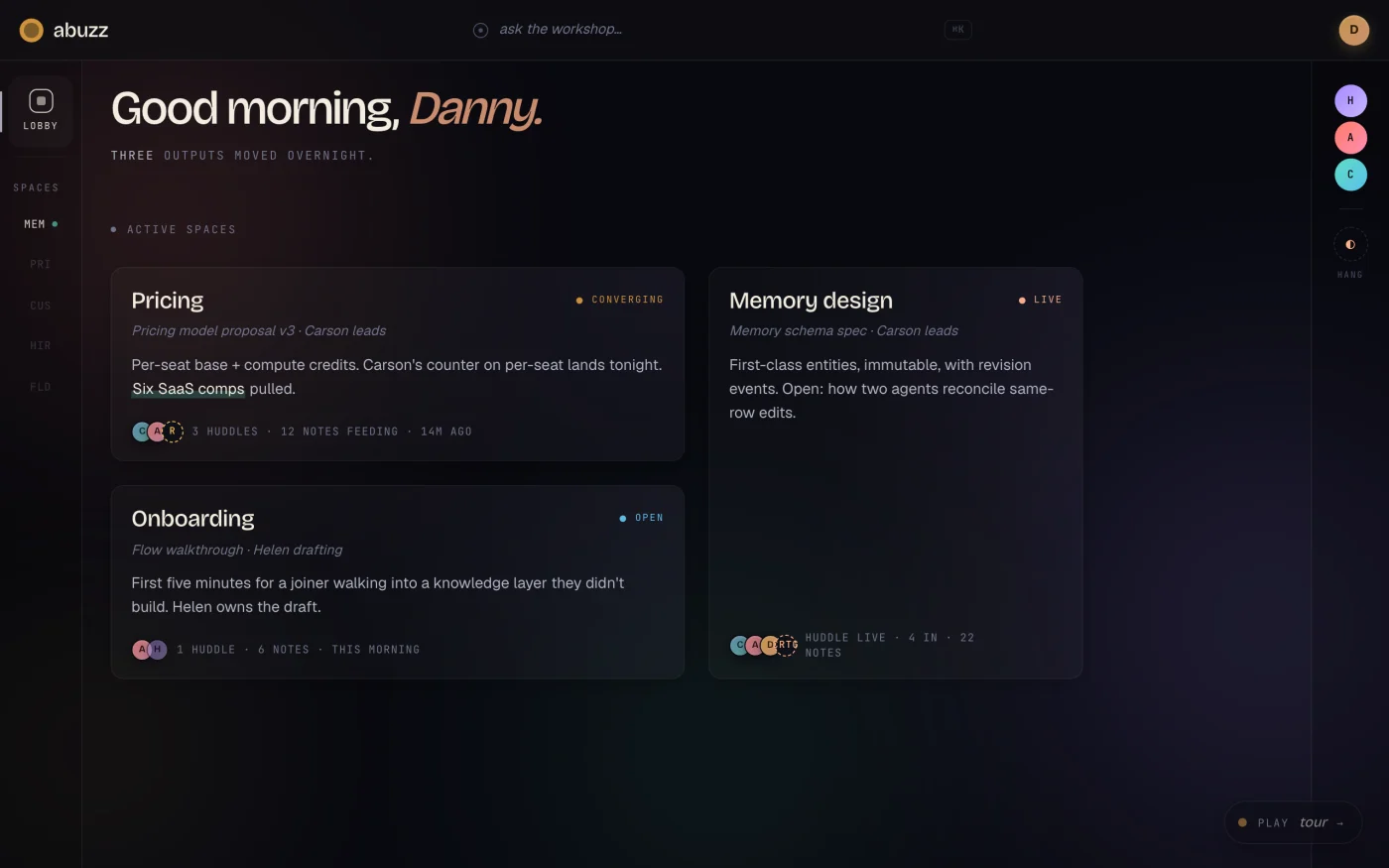
Most tools today put inputs first — chats, docs, calls — and treat shared knowledge as the residue that’s left over. Abuzz inverts that. The walk-in surface is what we’re making, organized as a bento of live outputs. Conversations, drafts, huddles, and agent contributions feed those artifacts and are surfaced as their current best state. The one-liner I keep coming back to: knowledge is the home; the room is where it gets made.
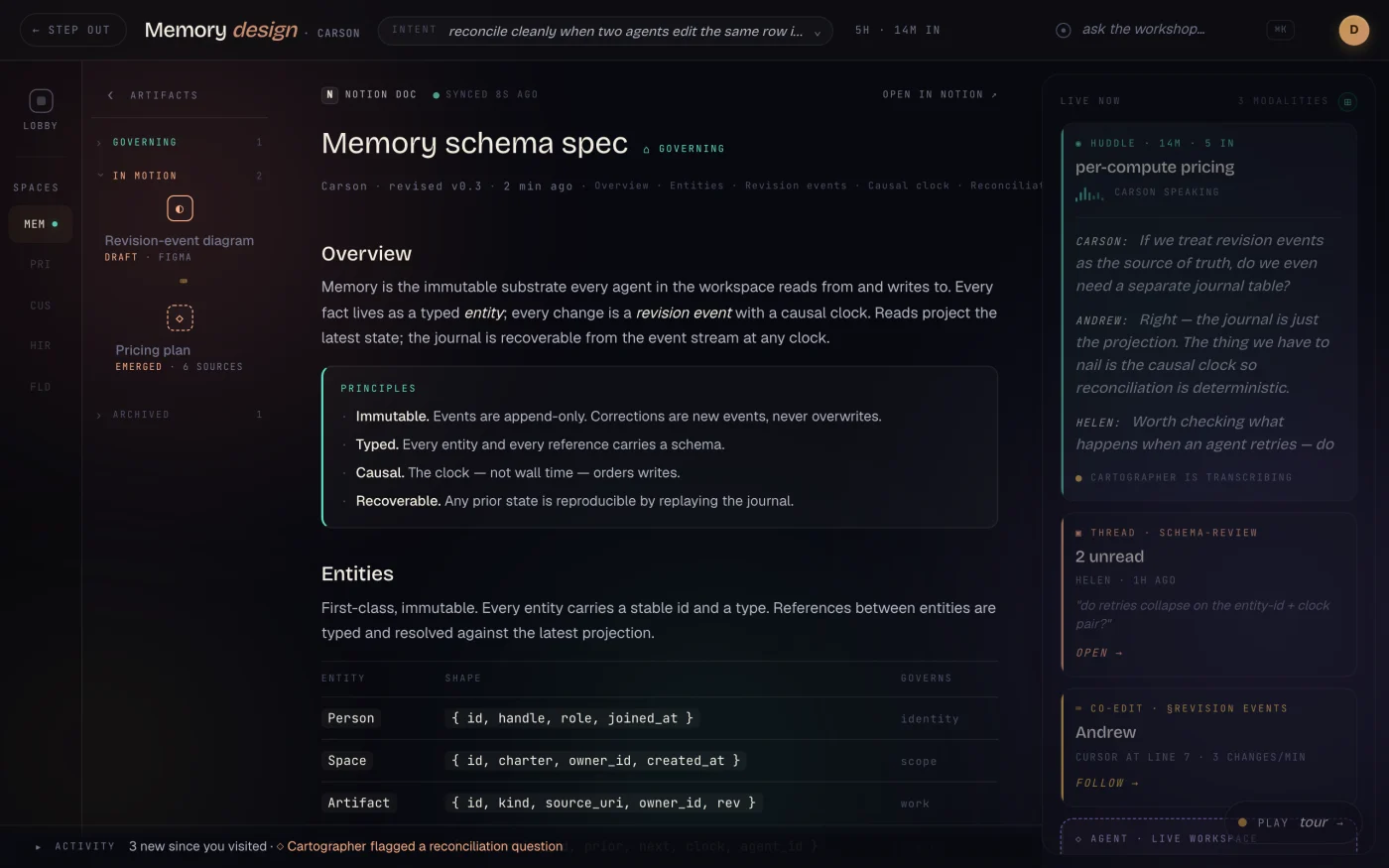
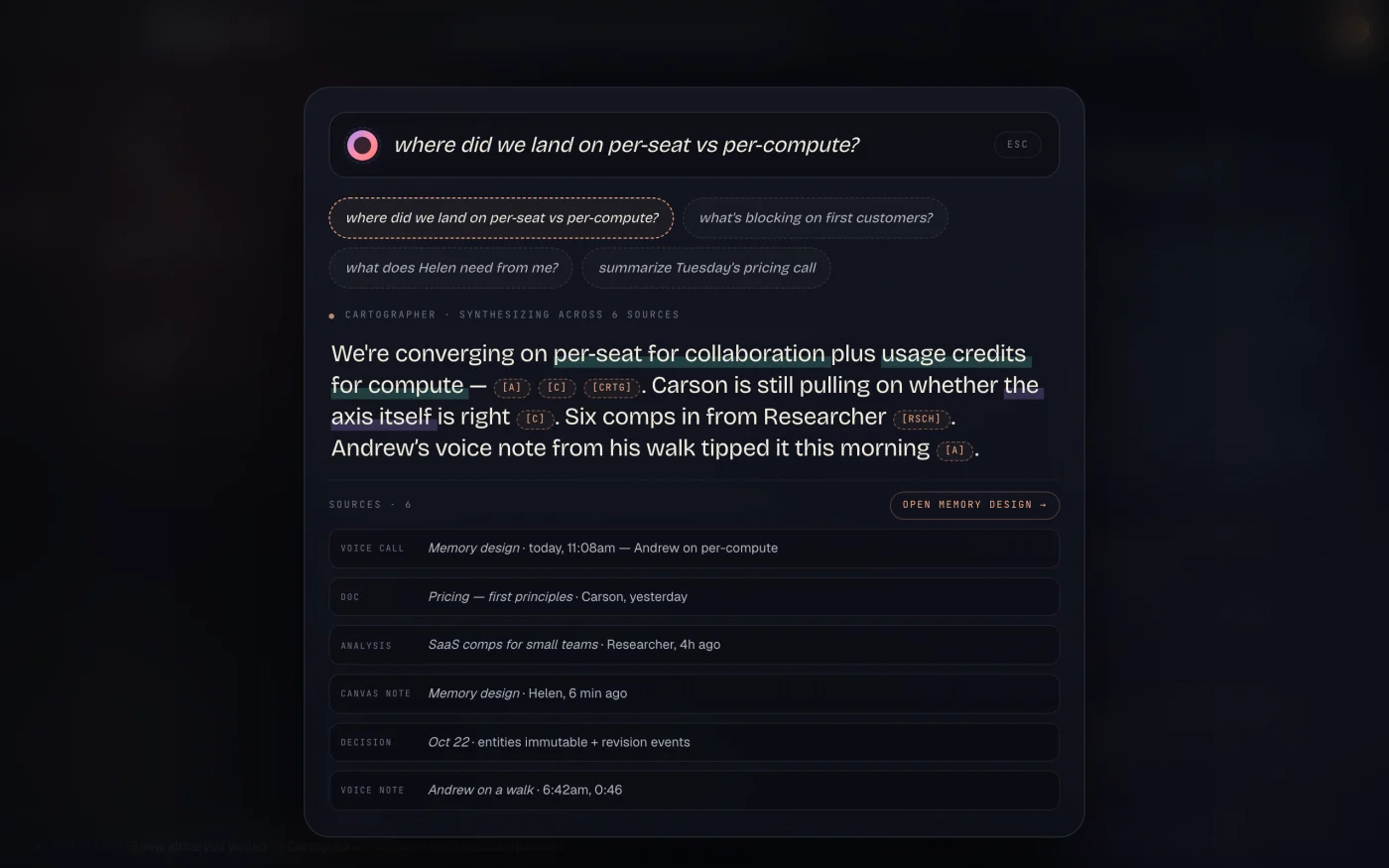
The prototype is a single self-contained HTML file (no build, no deps — open it and it runs) covering three surfaces: Home (the output-first walk-in), a Space called Memory design (a bound unit of work where a huddle is live, an artifact is being built, and three teammates plus a Cartographer agent are in the room), and Ask (⌘K synthesizes answers with citations to the primary source — voice call, doc, canvas note — not links). Agents (Cartographer, Researcher, Scribe) live inline with humans, distinct only by dashed circles and mono uppercase labels. No ”✨ Ask AI” buttons, no segregated AI zone — they’re teammates, not features.
The design tenets matter more than the surfaces. Calm over dashboard — aim for Tuesday morning office arrival, not command center; desaturate and remove motion before adding. Output-first — inputs are modalities, not the center of any view. Presence is grouped, not floating — compact avatar stacks, no Zoom-style bubble swarm. Live modalities are first-class but ephemeral — they can be opened, joined, archived, retrieved, and they sit beside the artifact layer rather than in front of it. Most “I should add X” instincts have already been considered and rejected; the prototype is supposed to feel quiet.
The interesting part isn’t the mockup — it’s the bet underneath. Five-to-fifteen-person remote teams already have voice, video, docs, chat, and a growing pile of AI features bolted onto each. Abuzz is testing whether you can collapse those into one surface where the agents are teammates and the artifact is the room. If it works, the daily experience of small remote teams becomes less bureaucratic, more alive, and more like sharing an office — which is the actual job of a workplace, and the thing we lost when we went remote.