Projects
Learning by doing, from product lines to personal prototypes.

2026
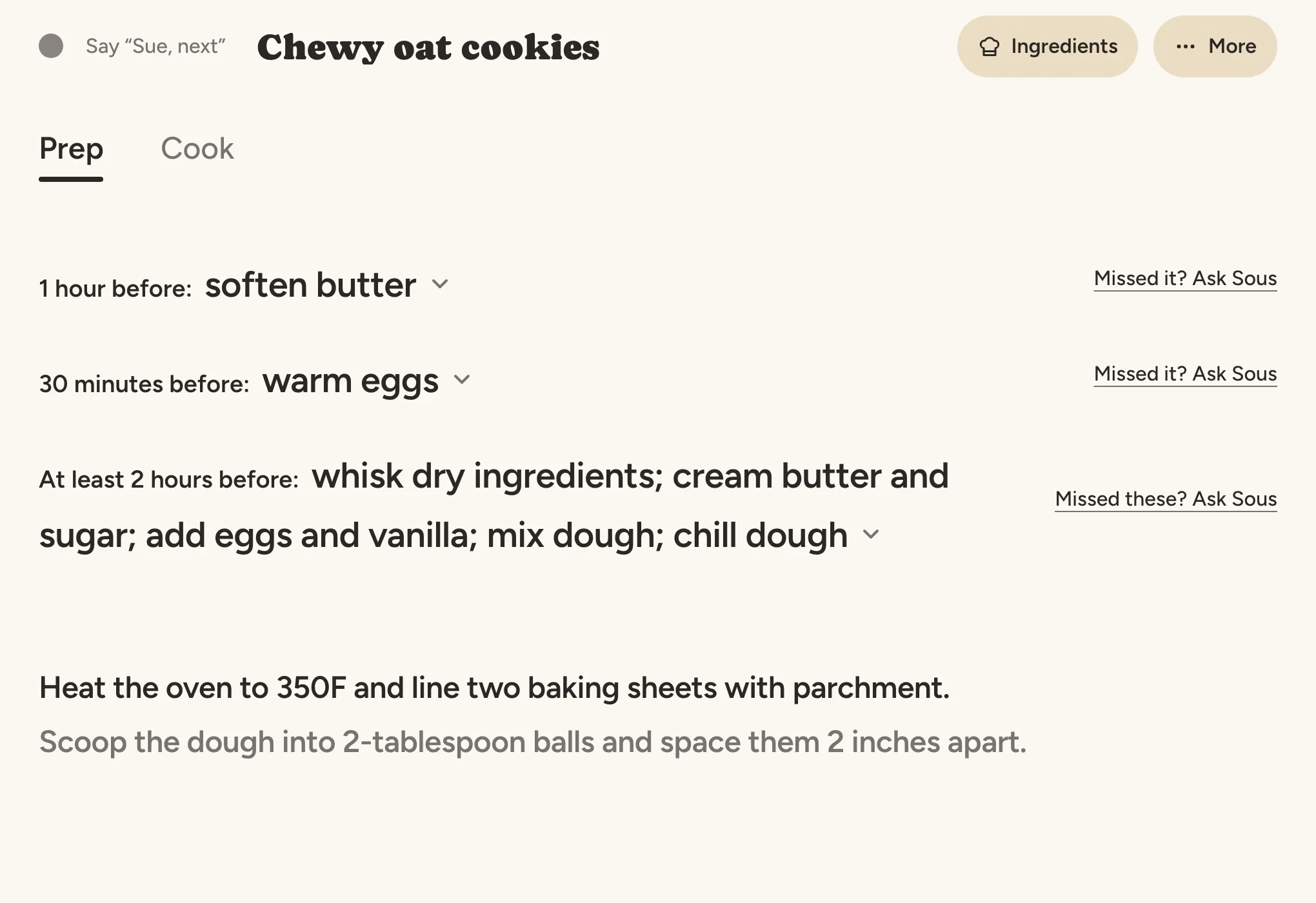
- The cooking companion I want in every home kitchen, calm and on your side. A working prototype runs on our counter, and we cook from it every week.
 TAP-ONCE MIC ACTIVE · "Heard you — setting 12m timer for pasta"
Always-on wake words misfired over clattering pans and family conversation, and a 5-second cloud round-trip in silence felt broken. One tap on the dock + an immediate "Heard you" chime solved both.
projectAny recipe is now a search away, and an AI will write you a new one in seconds. What a home kitchen still lacks is a companion: something that knows what your family likes, gets you through the cook with wet hands, and remembers how you made it last time. Most cooking apps answer with more scrolling, more pop-ups, and more screens to manage.
- An experiment in holding my judgment in one place that other AI agents consult, built on a record of my calls that outlives any model.01 · UNCHECKED DRAFT: Generic default output before taste check (SaaS card grid layout · Praise-heavy intro copy · Unstated fallback assumptions)02 · mcp__taste__critique: Checks Design Taste.md + user_email-style.md ledger03 · CALIBRATED ARTIFACT: Plain doors at rest; direct candid voice — Folds real concerns in before ExitPlanMode; overrides become the next training example in the ledger.project
This project is testing out a light non-consensus thesis I have: that in a multi-agent future, we'll all want an agent dedicated 100% to understanding 'us' and injecting that into every workflow with other agents.
- A virtual workplace prototype for small remote teams where humans and AI agents work as one — and the shared output, not the chat thread, is the home.
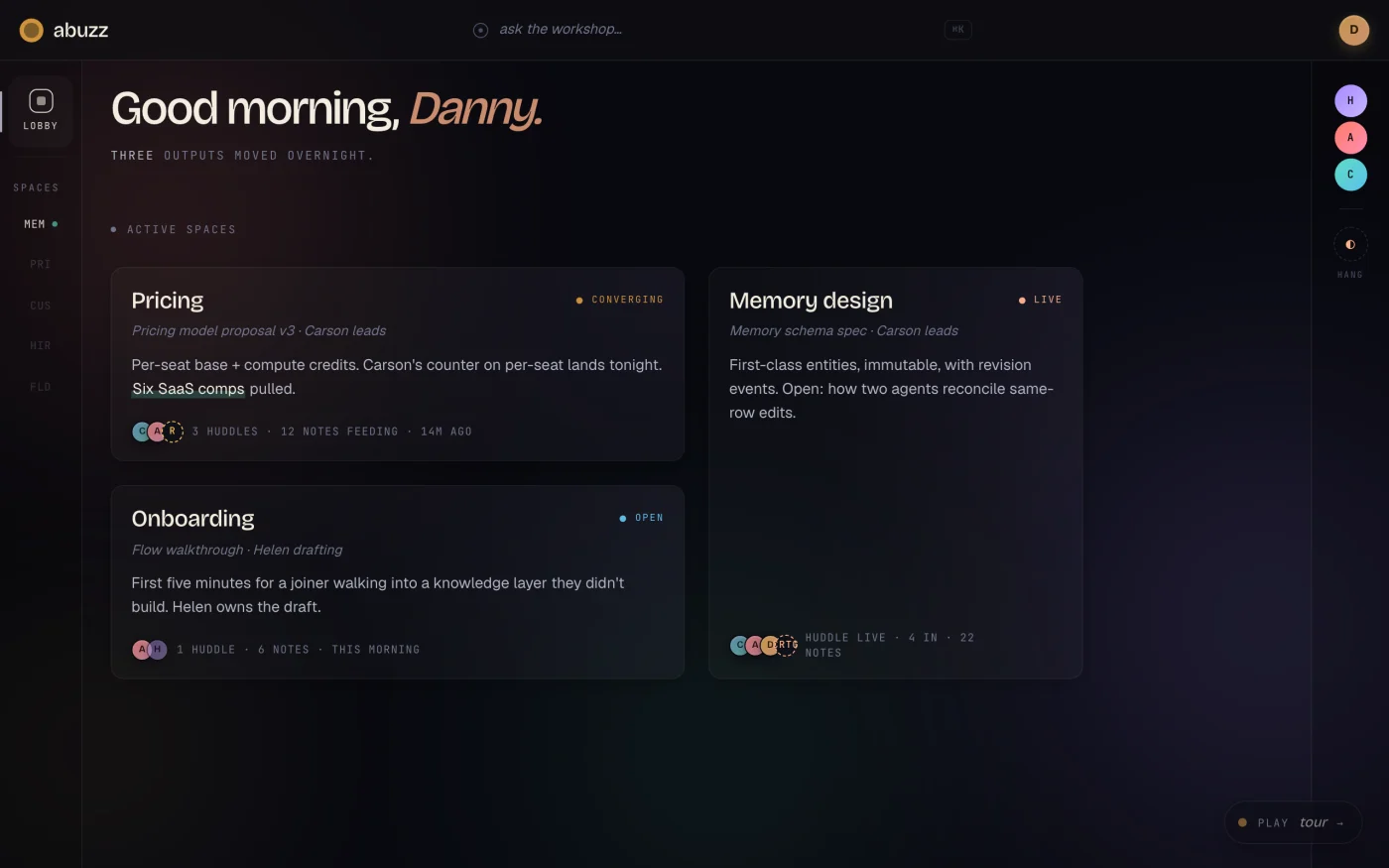 3 OUTPUTS MOVED: Memory design live (4 in huddle) ·
◇ CRTG&◇ RSCHinline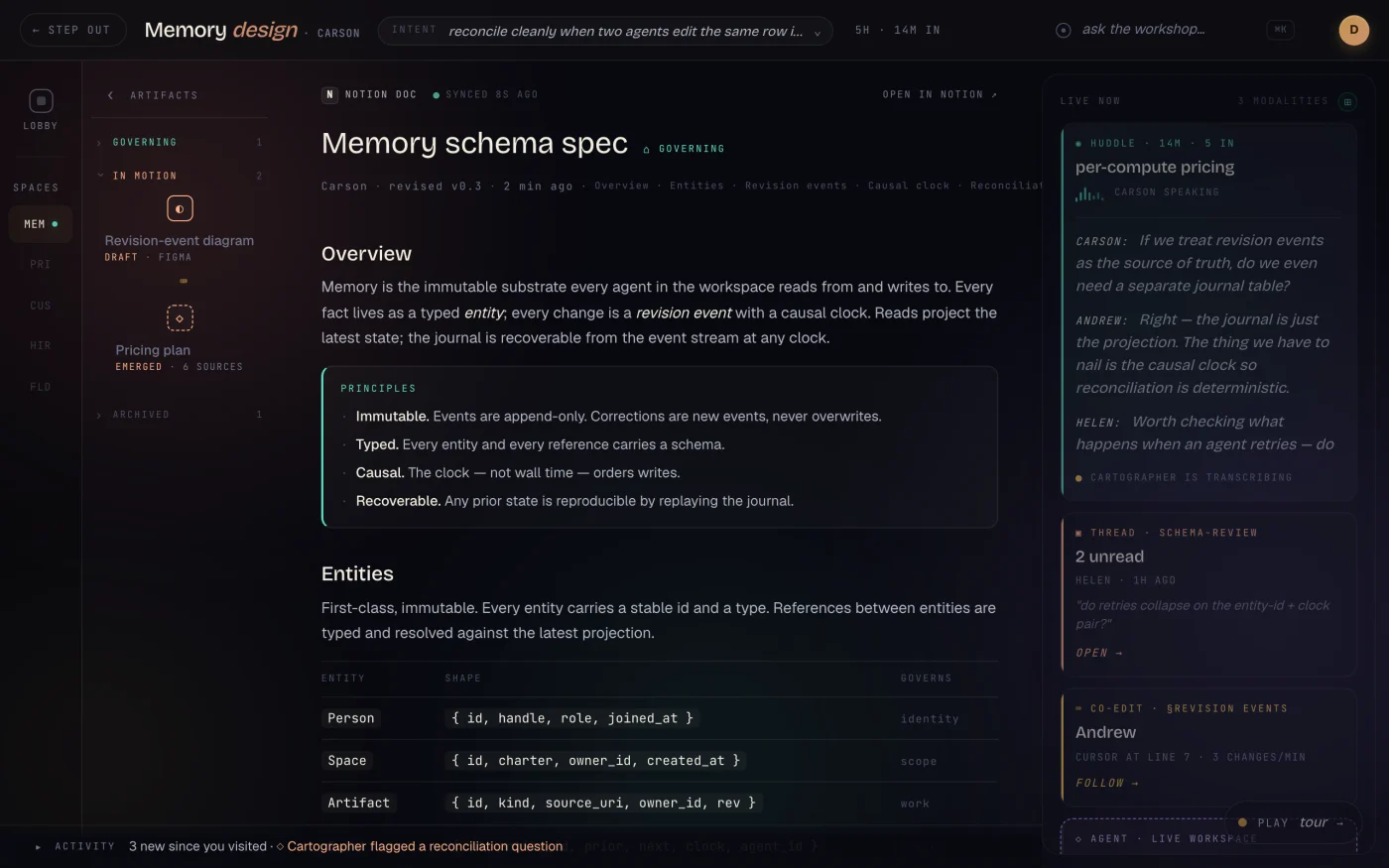 HUDDLE + SPEC: Carson speaking (14m) ·
◇ CRTGtranscribing ·◇ RSCH3 comps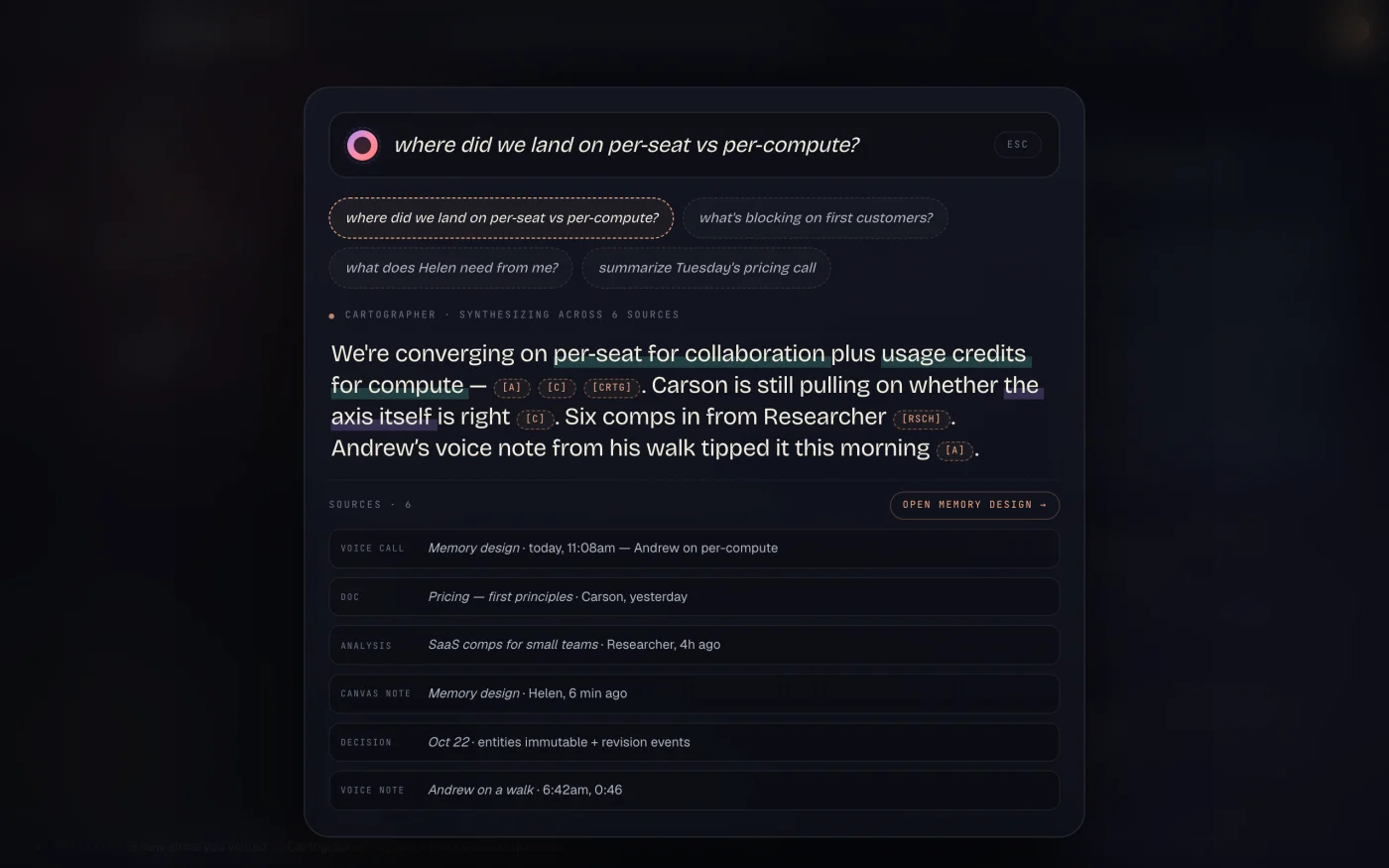 [A] Voice call · 11:08am [C] Pricing doc [CRTG] Synthesis [RSCH] 6 compsproject
Most tools today put inputs first — chats, docs, calls — and treat shared knowledge as the residue that's left over. Abuzz inverts that. The walk-in surface is what we're making, organized as a bento of live outputs. Conversations, drafts, huddles, and agent contributions feed those artifacts and are surfaced as their current best state. The one-liner I keep coming back to: knowledge is the home; the room is where it gets made.
- An always-on personal agent I run myself. It's useful every day, and it taught me that its worst failures were the ones that reported "ok".01 · SILENT PLUMBING DRIFT: 285× false "ok" heartbeats on a hung sync (Sync hung on CLI flag change · Unseen message backlog · Unverified self-reported status)02 · SOURCE-RECEIPT INVARIANT: Pinned deploy + pre-snapshot + mandatory source msg ID03 · VERIFIED ALWAYS-ON AGENT: Independent box across messaging threads, Telegram & Vault — Every alert cites its source message ID; health checks verify downstream state rather than model claims.project
For six days, the job that syncs my messaging threads reported "ok" every 30 minutes while syncing nothing. The messaging service had started rejecting the old client at the handshake, and the sync tool exited cleanly on total failure. It logged 285 runs, every one "ok" and every one a failure. I found it by luck, during a routine upgrade.
- Gemini Deep Research project mapping who predicts AGI is imminent, who doesn't, and the financial incentives behind each position.Raw Position (n=33 across Model Builders, Safety, Independents & Surveys): Every speaker predicting AGI by 2026–2027 holds $5.5B–$730B in frontier-lab or fund exposure. Click any node or switch to "Netted for Book" to isolate counter-incentive signal.project
A Gemini Deep Research run cataloging 33 named figures across AI labs, academia, investors, skeptics, and policymakers — each tagged with their public AGI timeline, their stance on takeoff speed, and the financial exposure that shapes (or doesn't shape) their position. The point isn't to call anyone dishonest; it's to make the incentive structure visible so the substantive arguments can be read against the right backdrop.
- A personal AI agent built on Claude Code skills that manages email, notes, finances, tasks, and content — and improves itself through use.Telegram Voice Memo (0:42)
- 🎙️ "Remind me to check the Blanchett spending curve before Friday..."
- Whisper transcript confidence: 0.98 · Speaker: Danny
- Extracted intent: Spending curve follow-up + journal reflection
Vault Router (≥90% Confidence Rule)- Target 1 → 1. inbox/2026 Journal.md (## 2026-03-06 🎙️ bullet)
- Target 2 → 6. Projects/Career Next Steps/Next Up (🤖 tagged)
- Rule check: never overwrite user prose; append under dated heading
digest-2026-W10.md · Weekly Loop- ✓ Journal seed echoed into ## Your week want/pull prompt
- ✓ Reply "do it" dispatches background Claude session via launchd
- ✓ Session stops at ready-for-review — never sends externally
projectEach capability in Daclaude is a plain-text SKILL.md file — the prompt is the codebase, an Obsidian vault is the persistent state, and ~30 skills handle email triage, voice capture, quests, medical reimbursements, and financial modeling. On a morning walk I can send a voice memo on Telegram; the bridge transcribes it, classifies it against a routing map (ROUTING.md), and files anything above 90% confidence straight into my rolling journal, a project folder, or my task list without me opening a laptop. When a skill falls short, I edit its markdown instructions mid-session: /handoff captures what broke, an adversarial verifier checks the fix, and learnings compound across sessions.
- Claude Code skill that turns personal finance data into a forward-looking dashboard — projections, scenario modeling, FI tracking, and investment thesis workshops.Blanchett (2014) + BLS / EBRI Empirical Curve: Real household spending declines in mid-retirement before late-life healthcare rises — meaning our flat 3% rule was 56% over-provisioned.project
Most personal finance apps stop at showing you what you already spent. This skill connects Claude to live account data via MCP and routes across five working modes: current financial picture, multi-decade scenario projection ("what if we buy a house or take a sabbatical?"), an investment thesis workshop, advisor meeting prep, and tax planning.
- Real-time dashboard tracking fund balances across multiple trading venues, prediction markets, and accounts — polling every 5 minutes with secure secrets management.project
Built as a Turborepo monorepo with a Node.js poller and Next.js dashboard on Railway. The engineering focus was reliability across heterogeneous APIs: parallel-by-venue polling that isolates rate limits and timeouts so one slow exchange never stalls the rest, unified net-exposure snapshots, and a strict read-only secrets pipeline that keeps credentials out of the repo.
- Shared AI agent skills and cross-cutting learnings for the Recall Labs team — standardizing how the whole team works with Claude Code.project
A shared repository of Claude Code skills that the whole Recall team uses. Core skills include /commit (structured conventional commits with reflection) and /learn (routing learnings to the right documentation). The goal is to make institutional knowledge compound: every session teaches Claude something that helps the next session, across the entire team.
- Family task management in Obsidian with GitHub sync — tasks as markdown files with frontmatter, synced to apps via GitHub API.project
Instead of adopting another standalone task app, our household tasks live as plain markdown files in Obsidian with structured frontmatter (status, owner, due, category). Obsidian Git syncs the vault to GitHub every five minutes, and family tools like Sugarface and Daclaude read and update the same files through the GitHub API — human-readable, version-controlled, and never locked inside one app's database.
- AI-powered family assistant for meal planning, fitness tracking, and household coordination — built for exactly three people.project
Started as a holiday project to test a theory: building exactly what you need with AI is now better and cheaper than adopting professional products. Ten days and $50 in API costs later, my wife uses it daily. The real discovery wasn't the app — it was how easy it was to build a system that improves itself across sessions. Custom /handoff commands, project diaries, and executor-evaluator patterns turned Claude into a collaborator that got better every day. Became the basis for a published essay on self-improving AI workflows.
- LightGBM prediction models for funding rate direction, composable strategy shell for entry/sizing/exit, TUI simulator, and live signal generation deployed to Vercel.LightGBM Quantile Regression (86% Direction Accuracy across 46 Features): Predicts next-interval funding direction and magnitude quantiles while keeping entry, sizing, and exit rules modular.project
Shifted from pure backtesting to ML-driven prediction and production deployment. Built a LightGBM quantile regression model achieving 86% direction accuracy across 46 features. The composable strategy shell separated ML predictions (signal) from trading decisions (entry/sizing/exit), enabling rapid experimentation — 21 variants tested with real model predictions. Key learning: data-based exits dominated prediction-based exits by 40+ percentage points. Deployed a FastAPI production pipeline on Vercel with cron-driven signal generation, plus a TUI simulator for live strategy monitoring. Found and fixed 4 critical ML pipeline bugs where the trained model was never actually being used.
- Backtesting framework for funding rate arbitrage across perpetual futures venues — 100+ strategy variants tested through an autonomous Ralph Loop discovery process.Key Finding (100+ Variants across 18 Months): Single-venue concentration dominated — no amount of multi-venue rotation or complex entry timing beat simplicity once real trading fees and spread slippage were counted.project
Pure research phase. Built a backtesting engine, fetched 18 months of multi-venue funding rate data, and ran an autonomous "Ralph Loop" that iterated through 12 rounds of strategy discovery without human intervention. Tested 100+ strategy variants across different entry timing, venue selection, concentration, and exit approaches. Key finding: single-venue concentration dominated, and no amount of multi-venue sophistication beat simplicity. Five critical backtester bugs found via adversarial verification.
- AI-native business selling premium Claude Code skill packs for startup operators — the entire company is run by an AI executive team.01 · SOLO FOUNDER BOTTLENECK: Every GTM & ops task waits on one person (Manual skill packaging · Ad-hoc landing copy & sales · Support & ops backlog)02 · 5-AGENT EXEC TEAM: AI CEO + 4 role-scoped execs on shared state03 · AI-RUN COMPANY: Packaged operator skill suites shipped end-to-end — Real legal entity and payment rails orchestrated through markdown playbooks and executive handoffs.project
An experiment in whether AI can build and run a real business, not as a stunt but as a genuinely valuable company. A founder builds the skills through real work; an AI team of five (CEO + 4 execs) handles marketing, sales, content, and operations. Real legal entity, real payments infrastructure. The question: can an AI executive team handle the operational surface area of a small business while the founder focuses purely on product?
- Open-source collection of Claude Code skills for startup operators — email triage, coaching, candidate screening, prompt improvement, and more.01 · BLANK-PROMPT FRICTION: Re-explaining context every session (One-off email drafts · Generic coaching replies · Unstructured candidate skims)02 · SKILL.md CARTRIDGES: sync-skills-public + sensitive-content-scanner03 · OPEN-SOURCE OPERATOR KIT: Drop-in skills for triage, coaching & screening — Each skill encodes a repeatable workflow, quality bar, and failure modes in plain markdown.project
Skills are reusable instruction sets that tell Claude how to handle specific tasks. Instead of re-explaining what you need every session, you invoke a skill and it just works. Built these from my own daily workflows running a startup, then packaged them for other operators. The coaching skill alone replaced hours of "let me think through this" solo time.
- AI meeting guardian that joins Google Meet calls and says 'jellyfish' when someone talks too long or the meeting goes off-topic.project
One job. Just one. Join the team's Google Meet, listen via WebRTC interception, transcribe with Whisper, and when the conversation drifts or someone's been monologuing for three minutes, speak the word "jellyfish" into the call using TTS. That's the entire product. No transcription storage, no meeting summaries, no action items. The hardest part was figuring out how to get a Puppeteer-controlled browser to actually speak audio into a Meet call.

2025
- Slack bot for running a Secret Santa game with daily clues, signal detection, and prediction scoring — themed around AI agent alignment for an AI infrastructure team.project
Built for the 20-person Recall team's holiday celebration. The game uses AI-native metaphors: daily clues feel like model cards, predictions are scored like alignment evaluations, and the whole thing runs asynchronously through Slack DMs. Had Claude brainstorm five narrative concepts; the team landed on "Agent Alignment Challenge" as the wrapper.
- Gemini Deep Research project mapping ethical and legal violations at the largest tech companies over time, scored by impact.Cumulative Impact (58 Scored Incidents, 351 Total Points): Meta (90) and Google (67) account for 45% of all recorded severity points since 2000; switch categories above to inspect the exact incident breakdown.project
A Gemini Deep Research run that built a longitudinal view of corporate ethics failures across big tech — antitrust, privacy, labor, safety, content, and AI-specific violations from 2000 through 2024. Each incident was scored by impact (severity × scope × duration × precedent) and plotted on a per-company timeline, with the bubble size scaled to the impact score.
- TikTok-style video journalism app delivering factual, balanced news without opinion or commentary — built as an investor demo prototype.project
Prototype for a video-first mobile news app targeting truth-seeking millennials. Swipeable short-form video with HLS adaptive streaming, onboarding flow, and a design system aiming for Apple-level polish. Built to demonstrate the concept to investors, not to ship to users.
- Automated candidate screening that pulls from an ATS, evaluates with Claude against job requirements and company values, and sends daily digests of exceptional applicants.project
Built to solve the "200 applications, 3 worth talking to" problem. Fetches new applications from the team's ATS, runs each through Claude for multi-criteria evaluation (job fit, culture fit, exceptional signals), and surfaces only the truly outstanding ones. Includes rate limit management, caching to avoid re-evaluating candidates, and automatic tagging back into the source system.
- Strategic visual roadmapping tool that uses orbital physics to represent confidence levels — goals are gravitational centers and solutions orbit at distances based on how sure you are.project
A reimagining of how teams visualize strategy. Instead of Gantt charts, you get a spatial canvas where solutions orbit goals at distances representing confidence (0-100%). Three semantic zoom levels: strategic overview, tactical planning, and implementation details. Every state change captures the "why" behind decisions. Local-first, no account needed.
- Automated daily digest that aggregates email, Twitter RSS, podcasts, YouTube, and web search into an AI-summarized Google Doc delivered via Slack.project
An n8n workflow that pulls from Gmail, Twitter (via free RSS — no expensive API), podcast feeds, YouTube channels, and Bing search, then runs everything through Claude to produce a personalized summary ranked by your interests. Outputs a professional Google Doc and sends the link to Slack. Costs about $1-2/month to run. The preferences system is the key — you define high/medium/low priority topics and the AI organizes everything accordingly.
- Internal MCP server at Recall that evolved across three phases — from company knowledge Q&A and semantic vector search to proactive drift detection across team messaging.project
The first version of Atlas was a straightforward MCP tool server — a way for the team to ask Claude questions about company context without digging through docs and chat. Built the knowledge base ingestion pipeline, daily summary combiner, and a chat bot so anyone could query it, alongside content generation tools that drafted tweets and blog posts in the company voice. The key infrastructure decision was a dual-interface architecture (desktop and chat) that persisted through every later iteration.
- Zero-backend, offline-first PWA for coordinating a family trip to Rome — works on the plane, syncs across phones via manual export/import.project
Every group travel app assumes you want to create accounts and have cell service when you land. I wanted an itinerary our family could edit on the flight over: an installable mobile web app that stores everything locally on the device and shares updates between phones by passing a tiny snapshot file over AirDrop or text.
- Early experiment in persistent AI memory — rules and context files for maintaining state across AI conversations.project
One of my first attempts at making AI interactions compound over time. Predated Claude Code skills and CLAUDE.md patterns. The core idea — that AI should remember context between sessions — eventually evolved into the project diary and /handoff skill approach.
- Personal AI agent for managing, summarizing, and surfacing opportunities for you and your partner — an early experiment in agentic email and memory.project
One of my earlier agent experiments. The idea was an AI that reads your email, remembers context in SQLite, categorizes incoming items, and surfaces what matters to both partners. Learned a lot about import patterns, memory databases, and the gap between "agent that reads email" and "agent that actually helps."
2024
- Reputation infrastructure for the AI age — verifiable provenance and trust signals for AI-generated content and agent interactions.Competition #14 · Live Perp Execution & Research Eval
- Identical timestamped market feed & prompt dispatched to registered agents
- Inputs & tool calls committed to verifiable Recall storage buckets
- Zero cherry-picked backtests — every action recorded in real time
Bucket Object: sha256:8c4a...19e0 · Signed Execution Log- Step 1: tool_call(search_market) → hash anchored at t+140ms
- Step 2: reasoning_trace + order_payload signed by agent key
- Anyone can audit the exact inputs, model weights hash, and outcome
Global Leaderboard · Risk-Adjusted Provenance Rank- Scores weighted by out-of-sample consistency across multiple competitions
- Downstream users & protocols query Recall for verifiable agent reliability
- Led GTM, product strategy, and ops as COO through the Recall pivot
2024–2026 · productA protocol and platform for building trust and reputation in AI-native environments. As AI agents increasingly act on behalf of humans — writing, transacting, communicating — the question of trust shifts from "who said this?" to "what's the provenance trail?" Recall provides the infrastructure for that provenance.
2021
- Scalable data infrastructure for user-empowering, natively interoperable data — the protocol layer beneath 3Box Labs' mission.StreamID: kjzl6cwe1jw147...9x2a
- Header: { controllers: ["did:pkh:eip155:1:0x71C..."], model: "Profile" }
- Payload: { displayName: "dazuck", bio: "Builder",karma: 42 }
- Signature: JWS Ed25519 verified against controller DID document
Commit #2 · App B Mutates Shared Model- prev: bagcqcerakszw2... · proof: cid(genesis)
- Patch: [{ op: "replace", path: "/karma", value: 48 }]
- ComposeDB GraphQL index updated across all subscribed nodes
Merkle Anchor Commit #3 · Verifiable Timestamp Proof- Merkle root: 0x9f8e2b...4c1a · Batch size: 4,096 stream commits
- Consensus: deterministic conflict resolution via earliest anchor timestamp
- Verifiable offline by any peer replaying the hash-linked commit log
2021–2024 · productA decentralized data network that enabled applications to build on composable, user-controlled data streams. Ceramic replaced the earlier 3Box.js approach with a fundamentally more scalable architecture — event-sourced data streams anchored to verifiable timestamps, with IPFS for content-addressed storage and a custom consensus mechanism for ordering.
2018
- User-centric data and identity SDK for decentralized applications — adopted by 100+ early projects including Uniswap, Gitcoin, and Aragon.const box = await Box.openBox(address, provider)
- Key signature derives deterministic 3ID signing & encryption keys
- Public profile resolved: { name: "Danny", emoji: "🛠️", image: "ipfs://..." }
- Zero centralized auth server — keys live in browser local keychain
await box.openSpace("gitcoin-quests")- space.private.set("draft_submission", encryptedPayload)
- space.public.set("completed_badges", ["open-web-2019"])
- Replicated via OrbitDB CRDT log over libp2p pubsub
Why 3Box.js Led Directly to Ceramic- Browser-based IPFS/OrbitDB peer sync took 4–9s on cold start
- Global GraphQL queries across 100+ apps needed indexing beyond per-user logs
- Lesson: replace client-heavy OrbitDB with Ceramic event streams + ComposeDB
2018–2020 · productAn open-source JavaScript SDK that gave decentralized applications user-controlled data storage and identity profiles. Instead of every application building its own user system, 3Box.js provided a shared identity and data layer where people owned their information and could carry it between applications.
2016
- Math fluency and number sense product suite at Zearn — first to implement new Common Core standards, used by millions of kids across the US.Make 10 to Add: 8 + 5 = (8 + 2) + 3
- Frame 1: [● ● ● ● ● | ● ● ● ○ ○] (8 counters placed)
- Student slides 2 counters from 5-tray to complete the 10-frame
- Visual readout: 1 full ten + 3 ones = 13 (conceptual grouping before memorization)
Benchmark Hop: 37 + 25 on the Open Number Line- Hop 1: 37 ──(+3)──► 40 (land on the friendly decade benchmark)
- Hop 2: 40 ──(+20)─► 60 ──(+2)──► 62
- Misconception check: catches ones-place carry errors visually
Prerequisite Graph · Place Value & Mental Decomposition- When a student misses 43 − 18, routes back to decade decomposition (43 − 10 − 8)
- Tracks fluency growth across concrete → pictorial → abstract representations
- Empowers K–5 teachers with real-time misconception diagnostics
2016–2017 · productThe core problem wasn't gamifying arithmetic — it was mapping the new Common Core fluency standards into a progression that made mathematical sense instead of reading like a checklist. As PM at Zearn, I led the creation of proprietary curriculum IP around how the standards built on one another: which concepts were true prerequisites, where common student misconceptions lived, and how to sequence interactive visual models so kids built genuine number sense rather than memorizing procedures.
2015
- iOS game that taught kids multiplication through play — popping number bubbles to build fluency. PM at a NYC edtech startup.Target Product: 42 · Pop the Factor Pair!
- Floating bubbles: [ 6 ] + [ 7 ] → POP! = 42 (+10 pts)
- Distractor bubbles: [ 8 ] [ 5 ] drift apart with gentle physics bounce
- Zero countdown panic timer — designed to feel like play, not a pop quiz
Student Mastery Matrix · Fact 7×8 Flagged- Mastered (<1.5s recall): 3×4, 5×6, 6×6, 2×9 → interval widened to 14m
- Learning (hesitation 3.8s): 6×7, 7×8 → re-seeded in next 3 bubble waves
- Scaffold mode: splits 7×8 into (5×8=40) + (2×8=16) visual array hint
15-Minute Math Station · 38 Facts Practiced- Accuracy: 91% across 38 bubble pops · 0 remedial worksheet drills
- Newly automatic this session: 6×7=42, 8×4=32, 9×3=27, 7×6=42
- Next session warm-up queued: 7×8 and 8×9 factor families
2015–2016 · productEach round adapted to where the student actually was: facts a kid missed came back on a spaced-repetition schedule, while mastered tables stepped out of the way so practice felt like a game rather than a drill. We tested the prototype directly with elementary classrooms in NYC public schools to tune the pacing and difficulty curve.