If AI Builds, Do Humans Shape?
When autonomous agents write and ship the code, the human job isn't review, specs, or management. It's shaping: deciding what should exist next.
At Recall we’ve been running a ‘dark software factory’: autonomous AI agents pick up goals, write the code, open pull requests, run tests, fix failures, and ship. We’ve had hundreds of goals executed, hundreds of commits per day. Most of the code in our newest repos was never typed or reviewed by a human hand.
This has pushed us to live one of the more interesting questions in software teams right now: if AI writes the code, what do humans actually do?
It’s not review, specs, or supervision
These were the theses last year. AI does this fine now, at a pace humans can’t keep up with. We’ll share more about how in a future post, but for now we’ll just say it’s pretty clear humans spec’ing just get in the way, and humans reviewing is an untenable bottleneck.
A more recent theme has been to treat the human role as management. Set priorities, assign work, track progress. But this is just project management with a faster workforce. You end up in Jira-with-robots, which is exactly as depressing as it sounds.
Jamming, shaping, taste-ifying
Increasingly we are spending our time “jamming” at a virtual whiteboard, shaping what the AIs will work on.
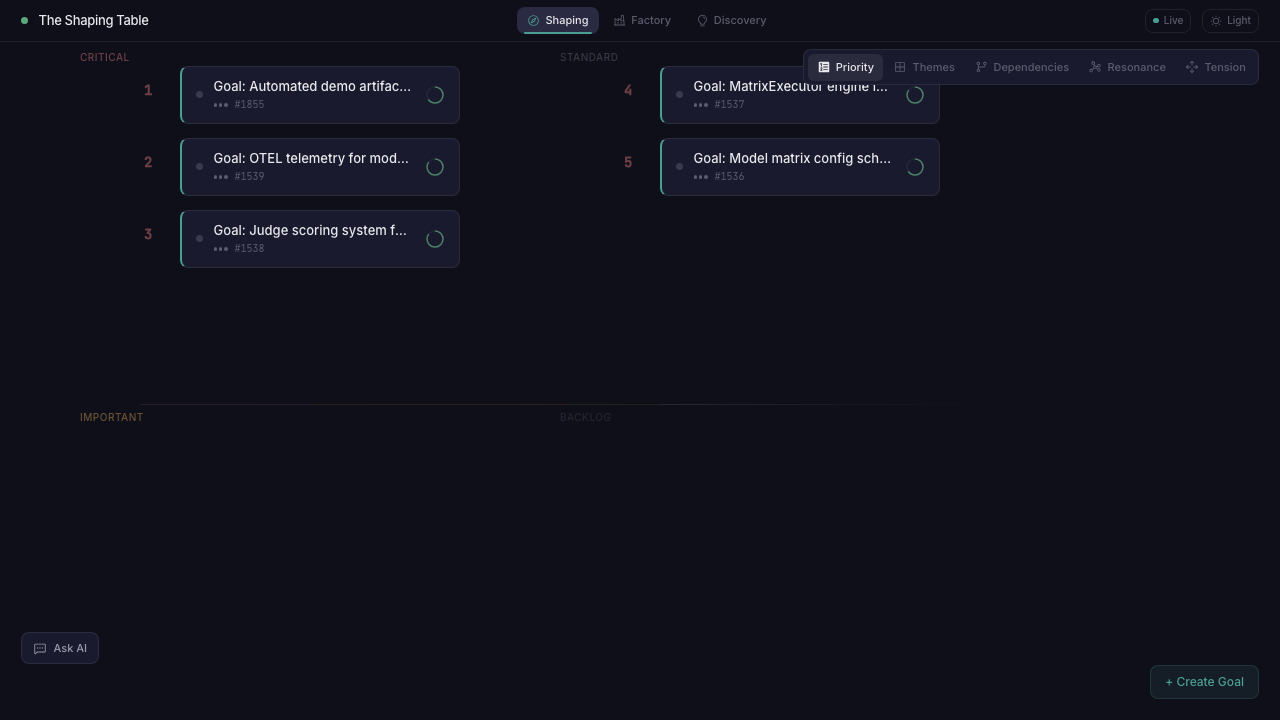
Shaping is the work of defining what should exist next in our product. It’s not spec’ing — we do not touch how things will be built, any implementation details, quality gates, none of it. (We actually have to train ourselves to stay away from these, because the AI software factory does worse when we interject there.)
Shaping is making sure that a Goal is well understood, defined, and aligned to the taste and stakeholder needs we’re trying to serve. It’s ensuring we know the outcome we want, the scope that makes sense, and how it relates to our strategy. It’s the input to the software factory.
To shape effectively, we built ourselves an app we call “The Studio” — a virtual whiteboard to make this new job as full-flow as possible.
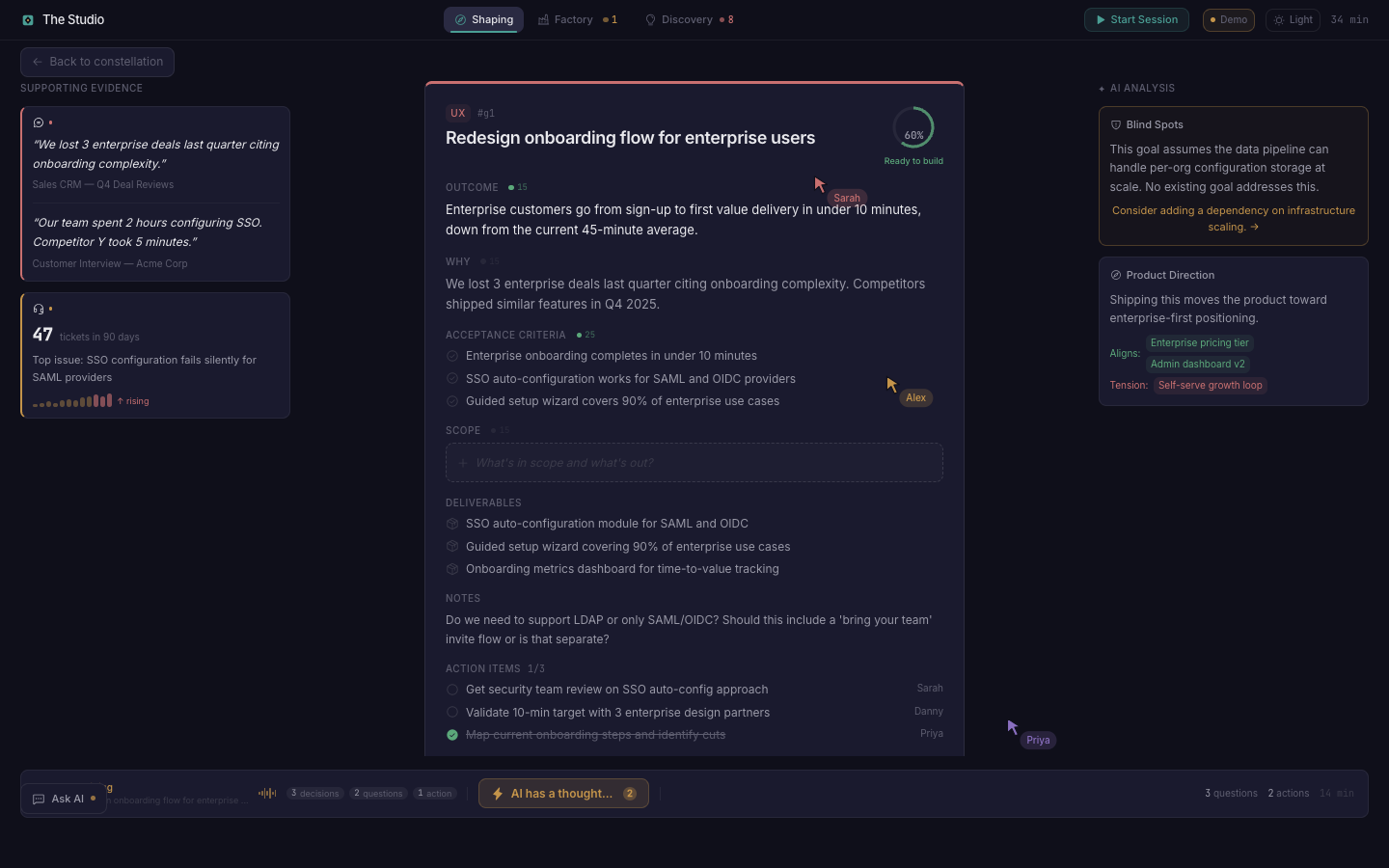
Goals are just GitHub issues, but we definitely don’t want to spend our time in the GitHub UI. So we pull each issue into a rich card, enriched with context from our internal systems — a tool called Atlas that curates context from across all our data — and project out the impact, risks, and strategic considerations of each goal. And because we know what makes a factory-ready goal, the UI shows us where we need to tweak things.
This is…fun?
This has reduced our team’s dread about the future of software jobs. Shaping IS the most fun part — the strategizing at the whiteboard with all the creativity and lightbulbs, before you have to go do the tedious parts of making something real. Shaping IS the thinking.
We sit with a spatial canvas of goals and see them in relationship to each other — which ones reinforce, which ones conflict, where the gaps are.
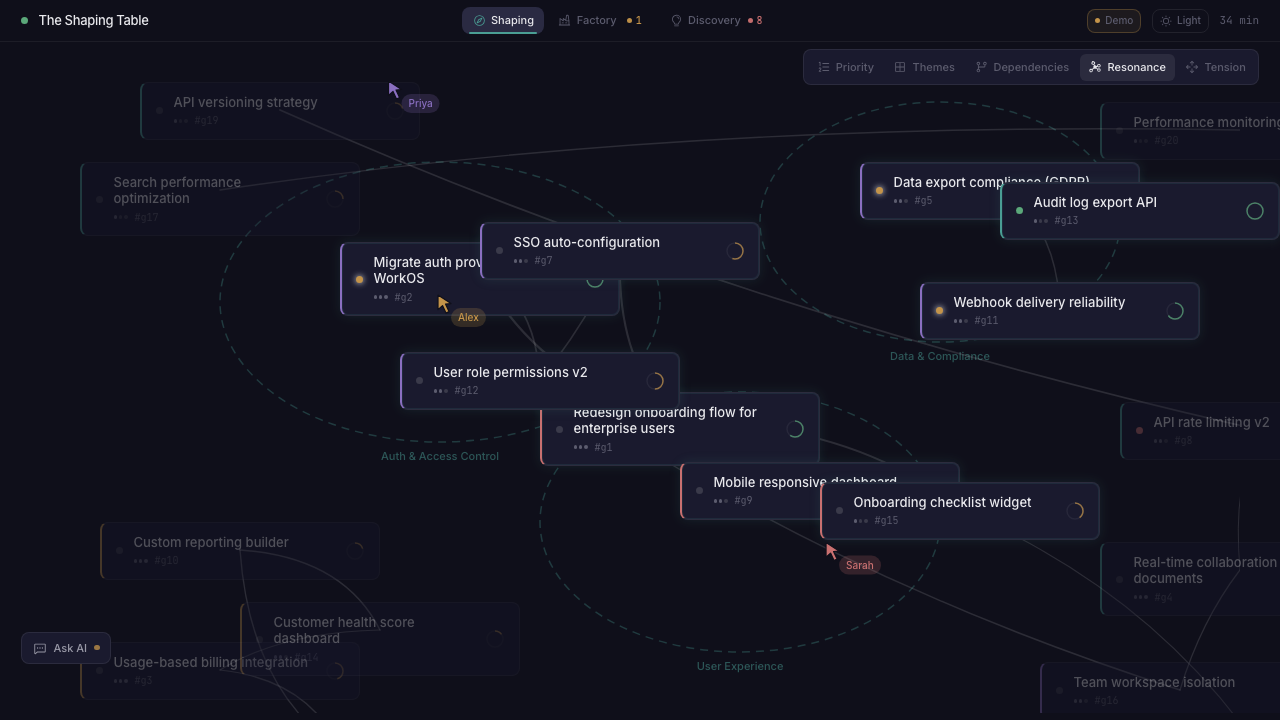
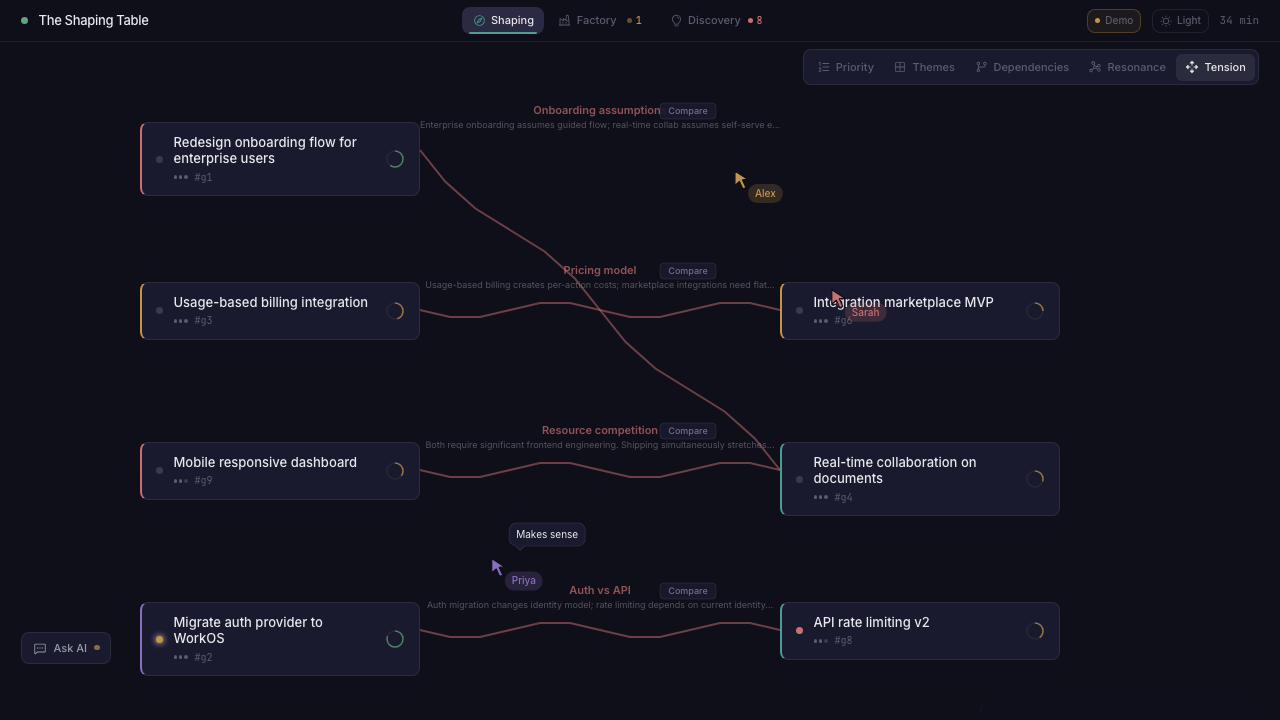
We do NOT spend time tagging and organizing and updating properties of goals. AI does this for us. We asked our Studio for layouts that show us which goals are in tension with each other, which amplify each other, and which conform (or don’t) to our stated strategic direction. The AI generates these views dynamically — they aren’t manually maintained.
When you remove the implementation burden, the remaining work is the most interesting part. Deciding what should exist. Understanding why. Defining the boundaries. Spotting the tensions between competing priorities. These are deeply human capabilities — spatial reasoning, judgment under ambiguity, strategic sense-making. The factory can’t do these. We can’t do what the factory does. The division is surprisingly clean.
The shape of what’s coming
I think every team that adopts autonomous AI execution will converge on some version of this. Not immediately — the first wave is supervision (review all the PRs), the second wave is management (prioritize the backlog), and the third wave is shaping (define outcomes with enough precision that supervision becomes unnecessary).
The tools for shaping don’t exist yet, mostly. We’re building one — a spatial canvas where goals, context, and relationships can be viewed dynamically. AI assists at every layer: scoring readiness, discovering relationships between goals, coaching on strategic alignment, and surfacing what the factory’s execution patterns reveal about your goal quality.
But the tool is less important than the realization: the human job in an AI-native team isn’t going to be managing the AI — that will just get in its way after the next round of harnesses. It’s going to be learning, thinking, and shaping what you want your dark software factory to bring into existence.