Hard Drive: Bill Gates and the Making of the Microsoft Empire
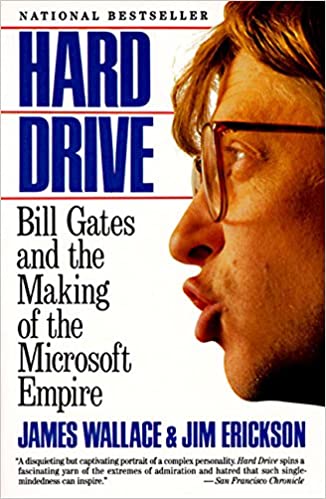 Hard Drive charts Gates’s missteps as well as his successes: the failure of OS/2 and the embarrassing delays in bringing Windows to the marketplace; the highly publicized split with IBM, which then forged an alliance with Apple to battle Microsoft; the public relations fallout over various exploits of Gates; and the investigations by the Federal Trade Commission. Wallace and Erickson also examine the combative, often abrasive side of Gates’s personality that has alienated many of Microsoft’s rivals and even employees, and led to his being labeled “The Silicon Bully” by Business Month Magazine. They report:
In the early 80’s, Microsoft’s Multiplan lost out to Lotus 1-2-3 in the marketplace. According to one Microsoft programmer, a few of the key people working on DOS 2.0 had a saying at the time that “DOS isn’t done until Lotus won’t run.” They managed to code a few hidden bugs into DOS 2.0 that caused Lotus 1-2-3 to breakdown when it was loaded. “There were as few as three or four people who knew this was being done,” the employee said. He felt the highly competitive Gates was the ringleader.
The first two female executives hired at Microsoft in 1985 were recruited to meet federal affirmative action guidelines so that the company could qualify for a lucrative Air Force contract. One source says,“They would say, ‘Well, let’s hire two women because we can pay them half as much as we will have to pay a man, and we can give them all this other crap work to do because they are women.’ That’s directly out of Bill’s mouth…” Gates treated one of these executives so badly that she asked to be transferred away from him.
Microsoft managers used the company’s e-mail system to secretly spy on employee work habits. Only those employees who worked weekends could collect bonuses. In time word got out and some employees logged into their e-mail on weekends with a modem from home so it would appear they had come in.
From Brainchild to Billionaire
Born outside Seattle to socially prominent parents, Gates was a gifted child with a photographic memory. He first encountered computers as a seventh-grader at the prestigious Lakeside private school, and quickly outstripped his instructors in expertise.
As a Harvard student in 1973, he spent most of his time playing with computers—and winning at high-stakes poker—but he never graduated. Instead, education took a back seat to ambition. In 1974, Gates and his friend Paul Allen developed a BASIC language for the Altair 8080, the world’s first personal computer. Surviving on catnaps and working on a Harvard computer rigged to mimic the Altair— a machine they had never seen—their program ran successfully the first time it was tried.”It was the coolest program I ever wrote,” Gates said, and it set the industry standard.
In 1975, with a vision of a computer in every home and the conviction that the fledgling computer industry was about to soar, the two formed Microsoft.Ironically, it was in collaboration with IBM—a company that dwarfed them in size, represented an entirely different corporate culture, and would later become a bitter rival—that Microsoft hit upon its greatest success to date. When IBM needed an operating system for its new PC, Big Blue turned to Microsoft. Gates turned to Seattle Computer products, a small, local computer company and, in what was one of a long series of brilliant business deals, purchased the rights to DOS for $50,000. Now labeled MS-DOS, it too became the industry standard and generates more than $200 million a year, helping to make Microsoft the most successful start-up company in the history of American business and enabling Gates to proceed with such projects as Word, Multiplan, OS/2 and Windows. When Microsoft went public in 1986, its shares were traded with a frenzy virtually unprecedented on Wall Street, and many of its employees became paper millionaires.
Hard Drive charts Gates’s missteps as well as his successes: the failure of OS/2 and the embarrassing delays in bringing Windows to the marketplace; the highly publicized split with IBM, which then forged an alliance with Apple to battle Microsoft; the public relations fallout over various exploits of Gates; and the investigations by the Federal Trade Commission. Wallace and Erickson also examine the combative, often abrasive side of Gates’s personality that has alienated many of Microsoft’s rivals and even employees, and led to his being labeled “The Silicon Bully” by Business Month Magazine. They report:
In the early 80’s, Microsoft’s Multiplan lost out to Lotus 1-2-3 in the marketplace. According to one Microsoft programmer, a few of the key people working on DOS 2.0 had a saying at the time that “DOS isn’t done until Lotus won’t run.” They managed to code a few hidden bugs into DOS 2.0 that caused Lotus 1-2-3 to breakdown when it was loaded. “There were as few as three or four people who knew this was being done,” the employee said. He felt the highly competitive Gates was the ringleader.
The first two female executives hired at Microsoft in 1985 were recruited to meet federal affirmative action guidelines so that the company could qualify for a lucrative Air Force contract. One source says,“They would say, ‘Well, let’s hire two women because we can pay them half as much as we will have to pay a man, and we can give them all this other crap work to do because they are women.’ That’s directly out of Bill’s mouth…” Gates treated one of these executives so badly that she asked to be transferred away from him.
Microsoft managers used the company’s e-mail system to secretly spy on employee work habits. Only those employees who worked weekends could collect bonuses. In time word got out and some employees logged into their e-mail on weekends with a modem from home so it would appear they had come in.
From Brainchild to Billionaire
Born outside Seattle to socially prominent parents, Gates was a gifted child with a photographic memory. He first encountered computers as a seventh-grader at the prestigious Lakeside private school, and quickly outstripped his instructors in expertise.
As a Harvard student in 1973, he spent most of his time playing with computers—and winning at high-stakes poker—but he never graduated. Instead, education took a back seat to ambition. In 1974, Gates and his friend Paul Allen developed a BASIC language for the Altair 8080, the world’s first personal computer. Surviving on catnaps and working on a Harvard computer rigged to mimic the Altair— a machine they had never seen—their program ran successfully the first time it was tried.”It was the coolest program I ever wrote,” Gates said, and it set the industry standard.
In 1975, with a vision of a computer in every home and the conviction that the fledgling computer industry was about to soar, the two formed Microsoft.Ironically, it was in collaboration with IBM—a company that dwarfed them in size, represented an entirely different corporate culture, and would later become a bitter rival—that Microsoft hit upon its greatest success to date. When IBM needed an operating system for its new PC, Big Blue turned to Microsoft. Gates turned to Seattle Computer products, a small, local computer company and, in what was one of a long series of brilliant business deals, purchased the rights to DOS for $50,000. Now labeled MS-DOS, it too became the industry standard and generates more than $200 million a year, helping to make Microsoft the most successful start-up company in the history of American business and enabling Gates to proceed with such projects as Word, Multiplan, OS/2 and Windows. When Microsoft went public in 1986, its shares were traded with a frenzy virtually unprecedented on Wall Street, and many of its employees became paper millionaires.